
'I visited Forth Valley College’s Skills Transition Centre to see how it helps students bridge the gap between theory and practice'
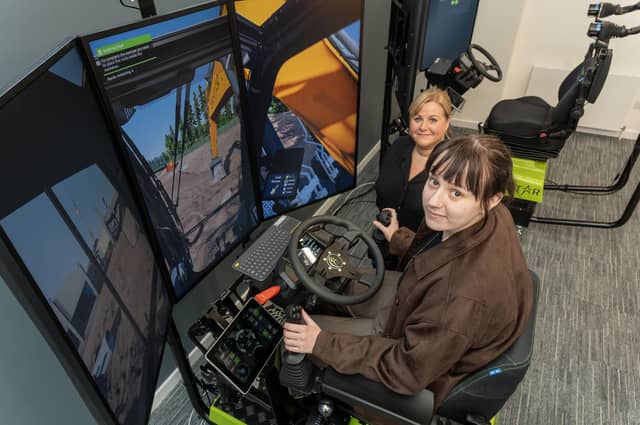

I visited Forth Valley College’s Falkirk campus to see how the Skills Transition Centre is working to open new career paths for students.
The Skills Transition Centre (STC) is home to an array of virtual reality and immersive technology which aims to support 1000 students into employment annually over the next decade by bridging the gap between theory and practice.
Virtual and augmented reality, robotics, drones, bioreactor kits, and interactive immersive room technologies are among the new facilities and equipment the STC brings.
After a brief tour around the centre, it quickly became obvious that students and staff alike share a passion for the new technology.
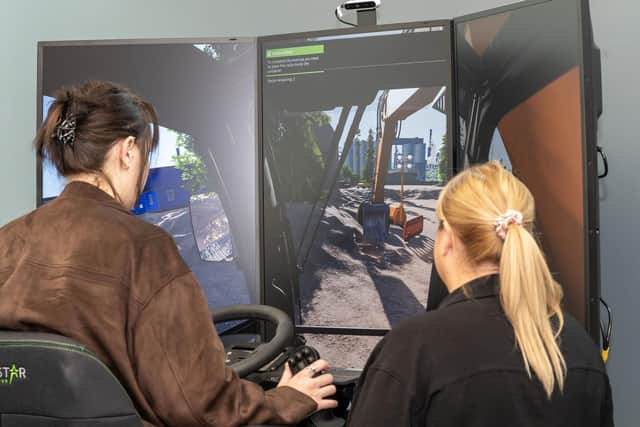
One room, which was the main focus of my trip, has two Ten Star training simulators where users can train on 14 different vehicles in 60 different modules.
Two desktop simulators are also part of the room, and Virtual Reality (VR) headsets allow learners to access a digital avatar that appears onsite alongside the vehicles operated by students on the Ten Star simulators. Through the VR headsets, students can build their teamwork skills and get a feel for how a construction site works.
For the first time in Ten Star’s history, an external screen separate from the training sims is central to the room to allow students to watch what other people are doing without crowding the machines.
The simulators allow you to train through their various modules, which can differ depending on the vehicle you select, or you can practice with some free roaming driving to get used to the controls.
Hopping onto the chair is an immersive experience in itself, the high up seat gets you in the headspace of driving a larger vehicle and the various controls which surround the chair mimic those in industrial vehicles.
In front of me were three large screens, with a fourth behind the seat to provide a rear view, and instructions for each module appeared in the corner. Once I chose my vehicle and module, removed my digital handbrake and started the engine, the seat juddered to mimic my chosen mode of transport pulling off.
I started with some free roam driving to get used to the controls, and was quickly drawn into the virtual world. When I accidentally crashed the digital lorry while attempting a tight corner, the movement of the chair mimicked the fake impact.
Up next was a module showing what aquaplaning and jack knifing feels like, to better prepare drivers on how to handle bad road conditions in real life.
As soon as my wheels touched the slippery surface, the steering wheel was ripped from my grip as I slid off the road and into the snowy woods - the speed of how it happened and the wildness of the wheel reflected what it feels like to lose control of your vehicle in real life.
The machines have had their sensitivity tailored in line with advice from Logistics UK to get them as close to the real deal as possible. They provide users with a taste of how each vehicle feels and works, giving them the confidence to pursue careers they may not have otherwise thought of.
Users can also get to grips with general driving, helping ease their nerves before starting driving lessons or sitting their theory test.
The equipment has been praised by several industry organisations, with some even hoping to use the technology to train current staff.
Across the centre, different rooms have been future-proofed with new technology which can be adapted to many different courses for various teaching methods.
The centre is also home to Scotland’s first life-sized hologram which can beam in speakers from across the globe. It can also display objects which students can interact with on a larger scale, and show pre-recorded messages, a feature which was recently used at the College’s graduation event.
Overall, each piece of the centre has been meticulously thought out to provide maximum benefits to students and entice visitors to explore the college.
The Skills Transition Centre was funded through the Falkirk and Grangemouth Growth Deal, and aims to drive innovation, reskill the local workforce, and contribute to more than 1,660 new jobs and £628 million in economic benefit over the duration of the 10-year project.