
Campaigners against AI data centre in Larbert remain "unconvinced" following online meetings over plans
Campaigners against a hyperscale AI data centre in Larbert say they remain unconvinced following online meetings hosted by the company seeking approval for its plans.
Developers Apatura hosted two ‘webinars’ over two nights – the first for people living close to the 55 acre site just off Bellsdyke Road, and the second for those from the wider Falkirk Council area.
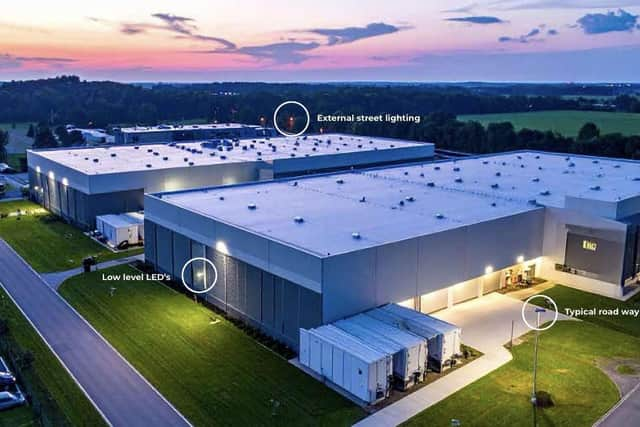

If approved, the centre would have two 25 metre tall buildings – with generator flues 28 metres tall – and an on-site substation and ancillary buildings.
The company says this will bring jobs and investment to the local community, but Falkirk Council has received more than 7000 objections to the plans, with thousands also signing a separate petition against the development.
While some object to AI data centres in principle, and in particular to the huge amount of energy they require to operate, others believe that Larbert is not a suitable location, particularly as the site is next to a care home and close to a hospital as well as thousands of homes.
When asked, ‘why Larbert?’, Apatura’s director of development Fraser Blackwood told those attending that the Glenbervie site had been chosen because it could get a direct connection to power at Denny Substation and was also close to a battery storage facility already owned by Apatura in Plean.
He stressed that Apatura will not be the eventual operators of the site and they are “in discussion with an experienced data centre operator”.
The former farmland, close to the M876, has good transport links and is also allocated for business use in the local development plan.
Mr Blackwood acknowledged the strength of feeling against the proposals that had been obvious during the pre-determination hearing held by Falkirk Council, and said they had been working since then to address some of the concerns.
Issues raised include fears of noise and those attending were told that the design of the data centre “does include a great deal of noise attenuation”.
Concerns have also been raised about the amount of water that will be used and the developers say that the closed cooling loop system means that 5.9 million litres of water will be used to fill the system just once, which would then only need occasional top-ups.
The company say it will be a condition of any planning consent that a closed loop system will be used and pledged that any excess will be taken off-site by tanker and any discharge monitored by SEPA.
One of the most controversial aspects of the application has been the need for more than 200 diesel generators, to be used as back up in the event of a power failure.
Mr Blackwood said they are looking to reduce the number of generators and the hours they will operate for testing, thus reducing nitrous oxide emissions.
The meeting also heard that fuel for the generators will be stored in purpose built underground tanks with procedures checked by SEPA and the Health & Safety Executive as well as Falkirk Council and the fire service.
The company has also submitted a full health impact screening to Falkirk Council that they say will be published soon and made available to the public.
Business consultants Glic reiterated that their modelling shows that 297 jobs would be created on-site by the proposed development, with a further 218 in the wider economy as well as hundreds of construction jobs.
They have also estimated that the development would bring £2.3 billion investment into the area.
Apatura also said that there will be a Community Benefit Fund that would generate £1.8 million a year that could be spent in the local area.
But residents who are campaigning against the proposal said that the meeting had not assured them, and many remained firmly opposed to the development.
Hazel McQueen, who lives just 20m from the site boundary said: “I felt I had no choice but to sit through a long, one-way presentation for two nights, listening to prepared answers while many of our questions and concerns were left hanging.
“It was frustrating and it left me feeling that locals had no real voice. Many questions were repeated from the previous evening and, although people in our group submitted many questions, lots went unanswered.
“We could only listen we couldn’t speak or challenge a response.
"This didn’t feel like community consultation.
“They say they want to engage with the community, but the webinar format gave us little opportunity to do so.
“We do not want this proposal to go ahead and to be honest nothing has, or will, change our mind on this.”