
Efforts to reduce A&E waiting times at Forth Valley hospital not being seen as numbers attending continue to increase
Health chiefs say that ongoing efforts to reduce waiting times in Forth Valley Royal Hospital’s emergency department are not yet being seen as numbers attending continue to increase.
Director of Acute Services, Garry Fraser, told members of NHS Forth Valley’s board that on one recent Monday, the Larbert emergency department had seen 263 patients, when a “busy day would be about 180 patients”.
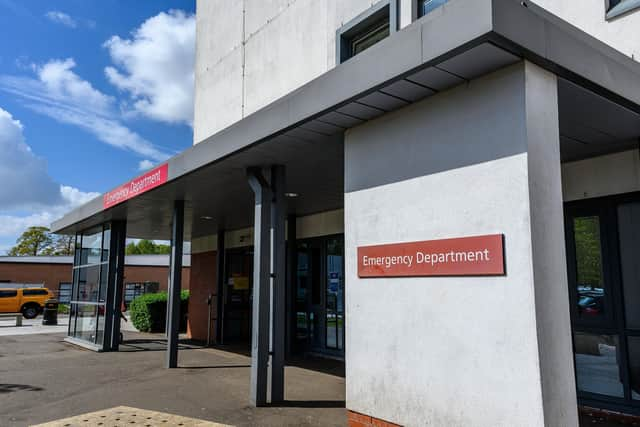

Mr Fraser said that the hospital is now regularly seeing more than 200 patients on a Monday and they are “exploring why that might be”.
The first half of the year saw demand increase by nearly five per cent on the same time a year ago, with occasional surges.
Earlier this year, the board agreed to use Scottish Government funding of £900,000 to employ more senior staff for the Emergency Department, to target times when fewer ‘decision makers’ were available.
New staff will be joining the team from November which Mr Fraser said “should help”, although he admitted that as demand has continued to rise it will still be a challenge.
The hospital continues to be full beyond its capacity, despite ongoing work to reduce the number of extra beds that have been put in wards to cope with ongoing demand.
The numbers have reduced from 130 per cent occupancy to 105 per cent, but it has been very difficult to get them any lower.
Chief executive Ross McGuffie told the board that any real improvements in ED waiting times would happen when occupancy was reduced to 90 per cent, adding that there is very good work happening but “it will take time”.
Mr Fraser said the NHS staff continue to work closely with partners, including Falkirk Health & Social Care Partnership, to ensure that patients were not in hospital when they did not need to be.
Staff are also trying to make the discharge process “a bit slicker” and the hospital has been trialling having consultants on duty at weekends in order to discharge people.
The figures presented to the board, for August, show that overall compliance with the four-hour emergency access standard (EAS) in August 2026 was 59.3 per cent, which includes Minor Injuries Unit 99.2 per cent and Emergency Department 45.6 per cent.
According to the performance report, a total of 3,240 patients waited longer than the four-hour target across both the ED and Minor Injuries Unit (MIU); with 1,540 waits longer than eight hours, 609 waits longer than 12 hours and 9 waits longer than 23 hours.
The main reason for patients waiting beyond four hours continues to be wait for first assessment with a cohort of 2,114 patients, noting this was 1,722 in August 2025.
Wait for a bed accounted for 568 patients waiting beyond four hours with clinical reasons accounting for 226 breaches.
In August there were 521 new attendances to Rapid Assessment and Care Unit (RACU), 97 of which were via ED. It is worth noting 1,100 patients that attended ED did not wait in August 2026 compared with 926 in August 2025.
Mr Fraser told the board that hospitals across Scotland were facing similar pressures and they were no longer getting extra funding for the winter, so were “working with the resources we’ve got”.
However, he also highlighted that Forth Valley’s performance has not reduced despite higher attendances and it does not have the very lengthy waits for ambulances or ‘corridor care’ that other areas are seeing.
He also pointed out that the efforts to improve discharge procedures also meant that last year only one day of planned care had to be cancelled despite the hospital being exceptionally busy.
Board chair Neena Mahal said that they “absolutely recognise that there are patients waiting longer than they should be”.
She said: “The clear message is that we are not being complacent – we are aiming to do better and we are putting things in place.”