
Looking back with Ian Scott on Falkirk district's steam connections
Each year in January the Friends of Kinneil gather in Bo’ness to remember the famous Scottish engineer James Watt on or near his birthday.
The genius who worked at Kinneil in the 1760s came originally from Greenock but Bo’ness and especially Kinneil can lay claim to a large bit of his story.

The efficient harnessing of steam power was, of course, one of the key moments in the early days of the industrial revolution and James Watt was the man who made it happen.
Before his experiments, the cumbersome and inefficient Newcomen steam engines were mainly used to pump water from coal mines – there was one in use in the Airth colliery as early as 1720.
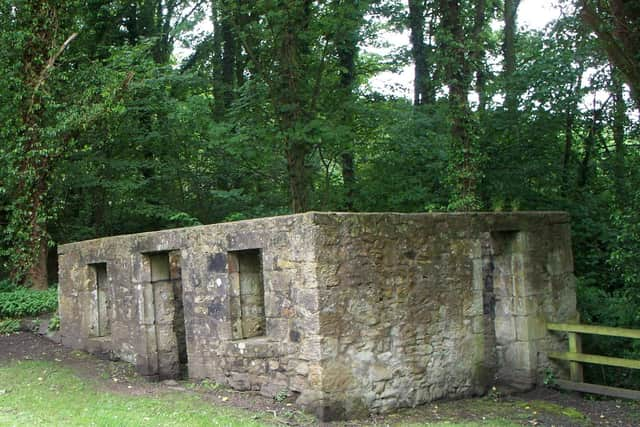
Working in the little workshop behind Kinneil House Watt perfected the ‘separate condenser’ which unlocked the mighty power of steam allowing the construction of engines capable of powering machinery of all kinds.
Almost overnight manufacturers were freed from dependence on water power and factories began to spring up in growing towns. The country and the world would never be the same again.
The little roofless workshop which helped usher in this revolution remains as a district link to the world of steam but it is not the only local connection.
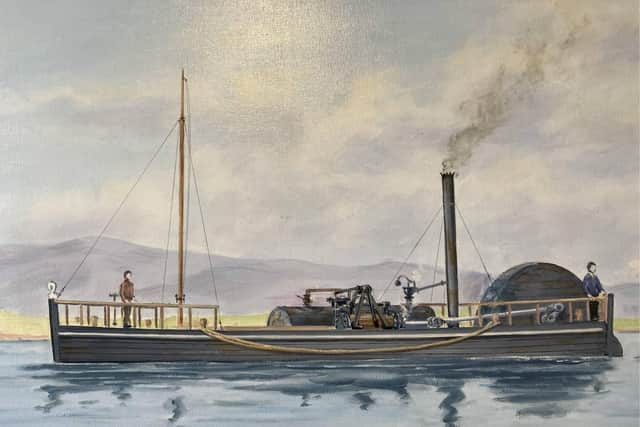
In 1801 another great Scottish engineer William Symington mounted a steam engine on a canal boat built in Alexander Hart’s Grangemouth yard and, as its paddle wheel powered through the waters of the canal, the Charlotte Dundas sailed into history as the world’s first practical steam boat.
Through the efforts of Ken Hutton and the Friends of Charlotte Dundas we now have an illustrated trail from the Kelpies along the Queen Elizabeth Canal; before that the only thing we had was a plaque on the wall of a building close to the site of the boatyard.
Another steam link takes us just a few miles away to the ruins of Torphichen Mill, the birthplace of Henry Bell yet another pioneer of steam navigation.
Henry attended school in Falkirk before serving an apprenticeship at a boatyard in Bo’ness.
He had an early interest in steam navigation and wrote to James Watt by then at the height of his success in Birmingham.
Unfortunately the great man poured cold water on his ideas but undaunted he exchanged more positive letters with Lord Nelson not long before Trafalgar.
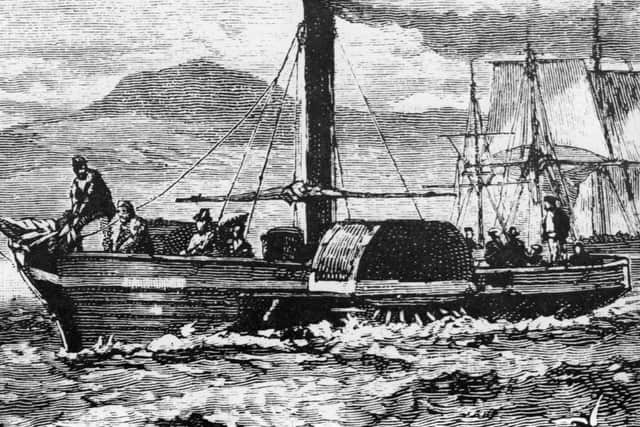
Marriage brought him to Helensburgh but it was across the Clyde in Port Glasgow that the famous Comet was built and launched in 1812.
It was a great success and, despite the powerful claims for American engineer Robert Fulton, over here we will maintain that the Comet was indeed the world’s first practical sea-going ship.
A few years after its launch Comet crossed Scotland via the canal to the Bo’ness yard where Bell had started work.
After refurbishment the great and the good boarded the boat for a sail down the River Forth to Leith.
The final piece in the local steam jigsaw is the famous Scottish Railway Preservation Society which operates both the Bo’ness and Kinneil Railway and the Scottish Railway Museum.
The SRPS has made a huge contribution to the story of Scotland’s industrial heritage for many decades now.
They also offer a brilliant afternoon tea on board a steam drawn train – I know because I was a happy passenger last week.
Sandwiches, scones and cakes while dreaming of the steam pioneers who changed our world forever. Nothing could be nicer.