
Grangemouth 50th anniversary service for 10 TA soldiers who died at Cromwell Weir

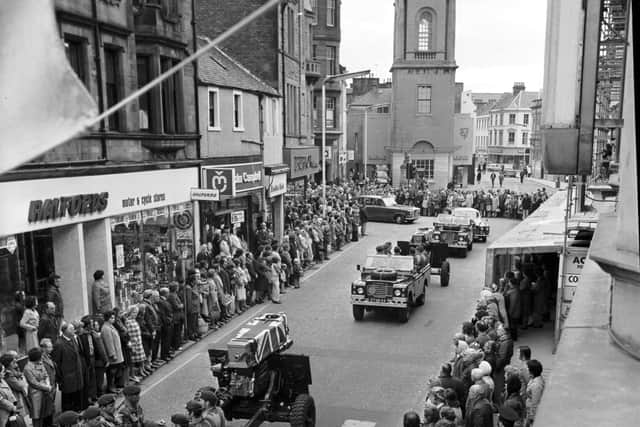
Heads bowed as the cortege moved through Falkirk town centre, the only sound from the wheels of the Army vehicles and the two gun carriages bearing the coffins of brothers Stuart and Peter Evenden.
Sadly remembered as one of the district’s darkest times, the pair were two of the ten part-time soldiers who lost their lives when a night-time exercise on the River Trent, several hundred miles from home, went tragically wrong.
As funeral services took place, people gathered in the streets to pay their respects and reflect on the loss of so many young men.
Now 50 years to the day since their deaths a memorial service will take place in Grangemouth this weekend.

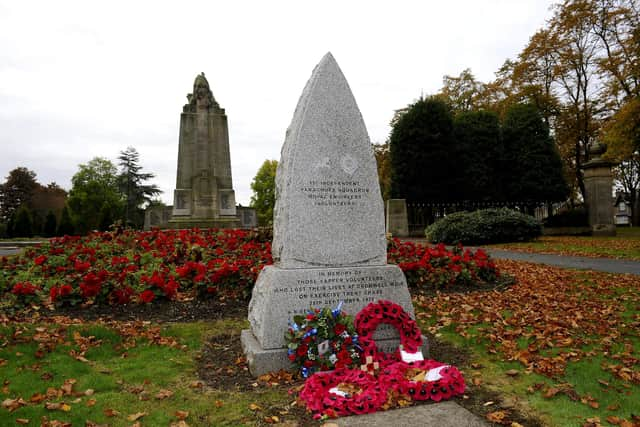
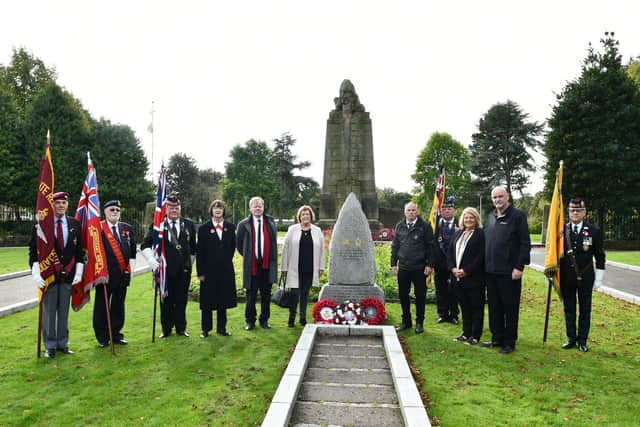
Family members of those who lost their lives will gather in the town’s Zetland Park at the memorial stone bearing the names of the ten, along with dignitaries, politicians, veterans, Armed Forces cadets and members of the community, to remember the Territorial Army soldiers.
Sunday’s service will begin at 11am but at 10.45am, as a mark of respect, the town’s MICC community alarm – usually only sounded to mark an incident involving industry in the area, will be activated.
The youngest of those who died was only 17 and the oldest 29 years. All had joined 300 Troop of 131 Parachute Squadron Royal Engineers for different reasons: some looking for experience before joining the regular Army, others to gain new skills but as they left their Grangemouth base for the weekend trip to Nottinghamshire, none could have envisaged the tragedy that was to unfold.
They were taking part in the annual watermanship exercise Trent Chase over 80 miles of the River Trent from Stoke to Hull.
On September 28, 1975 as the young soldiers’ boat made its way along the river, the weather deteriorated. Stormy conditions and an alleged power failure led to the lights along the river going out, and saw the young men unwittingly going over the weir, known locally as Devil’s Cauldron. The conditions were also worsened by a high tide.
Despite valiant attempts to rescue the Royal Engineer Regiment Sappers, only one man was pulled from the water alive, Lance Corporal Pat Harkins, 31.
He had clung on to the side of the upturned boat as the others were dragged under the water.
A bricklayer’s labourer, who had been in the TA for ten years, he was in charge of the boat.
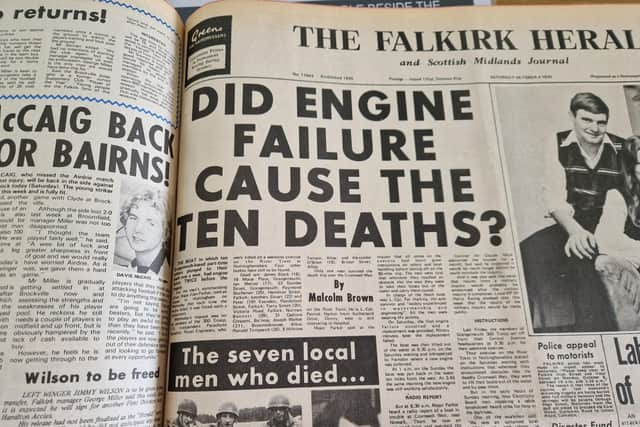
He was in the water for almost an hour before being rescued and taken to nearby Newark General Hospital. From his bed he told the Falkirk Herald at the time how he had hung on grimly to the boat.
He said: “This is the only reason I survived, I hung on to the handrail until I was saved.”
Although an inquest in 1976 did not assign any blame to Lance Corporal Harkins, he never publicly spoke about the events again, living quietly in his Denny home until his death in 2012.
Those who died were Raymond Buchanan and Terry Smith, both aged 20; James Black and Alexander O’Brien, both 18; Ronald Temprell, 26; Joseph Walker, 21; brothers Stuart, 22, and Peter Evenden, 19; Norman Bennett, aged 29; and the youngest victim Ian Mercer, aged only 17.
The alarm had been raised by electricity board staff, who were fixing navigation lights on the weir.
Four police officers were sent to the scene and one of those, David Smith, now 70 and a retired inspector living in Cornwall, recalls the terrible events.
His voice often breaks with emotion as he remembers what happened, saying: “All we knew was that people were in the water, we didn’t know it involved soldiers.
"It was pitch black and we didn’t have mobile phones or even radios in those days. We could hear random voices coming from the river and thought it was fishermen or a houseboat that had sunk.
"We did our very best to save them – no one could have done more but sadly we were only able to pull one man from the water.
"We had no concept that there were soldiers in the water. We just knew there were people who we had to try to help.
"But the weir is a giant Edwardian concrete structure and it is known as the Devil’s Cauldron for a reason.”
A row boat was lowered into the water and David and his colleagues climbed down the metal rungs on the weir wall to get into it before rowing into the centre of the water.
“We lost contact with everybody else. The noise, spray, turbulence and darkness closed everything else off from us. We had no idea what was going on. It was noisy, it was wet and it was terrifying as the weir grew closer and loomed over us cutting out all other scenery and almost any light.
“We reached the centre of the river, and stopped about ten feet away from the bottom of the torrent. The waterfall was towering above and on three sides, and the river boiled all around us.
“Suddenly the shape of a boat hull surfaced from the cauldron directly in front of us, and our torches showed that there were people. I didn’t know if they were alive or dead. A moment later the boat, and the people, were sucked away again.”
David and his colleagues manage to pull Pat Harkins into their boat and get him to safety.
Sadly, the others that they found were already dead.
"In the days afterwards what I couldn’t stop thinking about was that these were young men, most ages with me and they had lost their lives so tragically.”
Some of the bodies were carried downstream and for some of the relatives, who, alerted by the Army, had made their way to Newark, for three days had hope that their loved ones would be found alive but this was not to be the case.
David said that it was only in days afterwards that he fully began to understand the extent of the tragedy.
An inquest was held the following year when an “open” verdict was given that all ten had died by drowning.
To this day, it remains the largest peacetime loss of life for the military.
As well as the Grangemouth memorial, as stone was erected next at Cromwell Lock, opposite to the weir, made of Scottish granite, with the names of the men inscribed on a bronze plaque.
David Smith said he has only visited it once on the 40th anniversary.
"My former colleague Albert Walker lived nearby and he would go every year. The anniversary came shortly after he died and I decided to go in his place. but I can’t bring myself to go again.
"Too many sad memories – but I think about those young men often.”