
Looking back with Ian Scott: The story of Falkirk in 12 objects, part three
This week I want to describe the final four objects that tell me something important about the history of Falkirk. I have a personal connection to all four which makes this week’s choices especially significant to me.
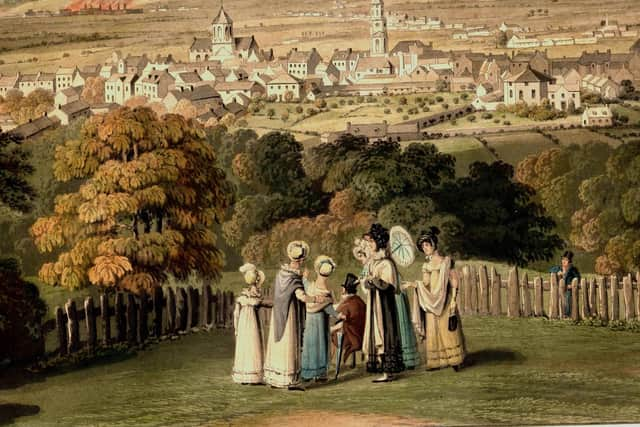
The first is a coloured engraving which hangs on the wall of my little home office. It was drawn by a man called John Clark who had a commission from a London company to produce several engravings of Scottish towns and thankfully Falkirk was one of them.

The year was 1824 when the market town was on the cusp of a transformation to an industrial centre. Prominent buildings appear for the first time - the new built Parish Church (now Trinity) opened in 1811, the new Town Steeple in 1814 and the little octagonal Tattle Kirk (1806) in the Cow Wynd.
The long High Street stretches from west to east as the main throughfare as indeed it does today but then there was little else. Perhaps the most significant part of the image is in the north west corner of the picture where the blazing blast furnaces of Carron ironworks appear in the distance across the open fields from the town. The space between would soon fill up with dozens or foundries changing Falkirk forever. The artist chose as his vantage point Henry’s Hill on high ground to the south of Callendar House.
My second object today takes us back to a problem that haunted the expanding town throughout the 19th century – water, or the constant shortage of a dependable supply.
Fixed to the outside wall of my house is a cast iron street name plate which was rescued from the rubble of the demolished Cistern Lane. In the early century the Stentmasters, then in charge of the town tried to solve the problem by building a large stone reservoir.
The lead-lined container was 18 foot long by 11 foot wide and 9 foot deep and contained 13,000 gallons. It was repaired several times until a new water supply from the Denny Hills was installed and the old cistern became for a time Falkirk’s first public convenience. The name plate on my wall reminds me of the birth pangs of the town as it emerged as the major settlement in east Stirlingshire.
My third object is in the keeping of Falkirk Museum and lives in the museum store in Abbotsinch, Grangemouth. It is the restored Falkirk Tram, a survivor of the 30 years of our electric tramway system which ran round the circular from 1905 until its demise in 1936.
It was a huge success, loved by all except perhaps the bus companies who killed it off in the end. The restoration project in the 1980s did promise to put this one back on the road or in Callendar Park but nothing happened. Is it too late to try again.? I hope not.
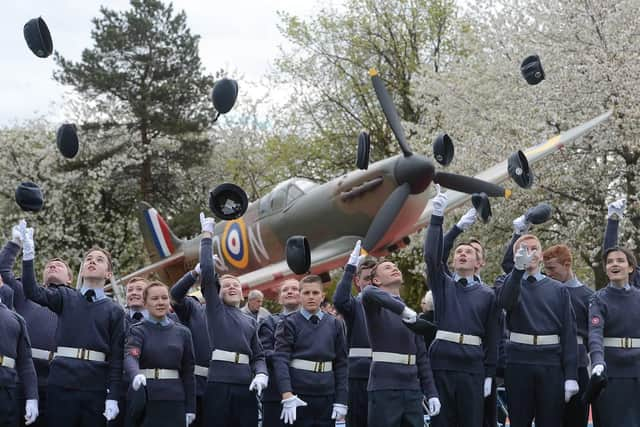
My final object is the magnificent replica Spitfire on the Bo’ness Road unveiled in May 2013. Inspired by the local air cadets it marks the service, and death in service, of dozens of young men from all over the world who lost their lives at Grangemouth aerodrome while training for action over Europe. It stands as a reminder of the impact of the wars of the 20th century along with the other War Memorials throughout the district.
So there you are: 12 objects that tell part of Falkirk’s story. What would you add or subtract?