
Looking back with Ian Scott: The story of Falkirk in 12 objects, part one
A few years ago the BBC broadcast a series of programmes in which Dr Neil MacGregor described ‘A History of the World in 100 objects’.
It was great, and inspired Elspeth King over in Stirling’s Smith Art Gallery and Museum to select 100 objects telling the history of Stirling in the same way.

Not long after, our own Geoff Bailey gave a presentation called the ‘Story of Falkirk in 10 and a half objects’ which is still available on the local history society website.
Today I thought I would follow with my own selection and I have chosen 12 things that tell me something important about the district we live it.
This will take me more than one week so I will bash on with the first four today. They are in chronolgical order.
My first choice is the oldest and most recently discovered – the amazing 4500 year old Bronze Age Burial Urn found in Williamson Street when Mathieson’s bakery was being demolished in 2019. The decorated earthenware ‘collared urn’ contained the charred remains of two humans who lived and died in Falkirk 2000 years before the Romans appeared. The urn was unbroken and stood more than 30 centimetres high. It will no doubt end up in the National Museum in Edinburgh.
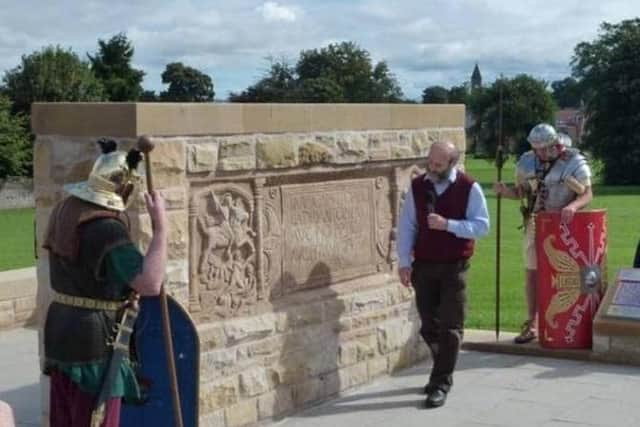
My second object is the Roman Distance Slab discovered in Bridgeness in the late19th century recording the construction of the eastern end of the Antonine Wall in the second century AD. Like the urn, it is not in our area but the good people of Bo’ness, anxious to preserve their local history, commissioned the production of a magnificent full sized replica of the stone using laser technology. It now stands in Kinningars Park on Harbour Road and is a must visit for anyone with an interest in our heritage. The two carved panels are simply stunning.
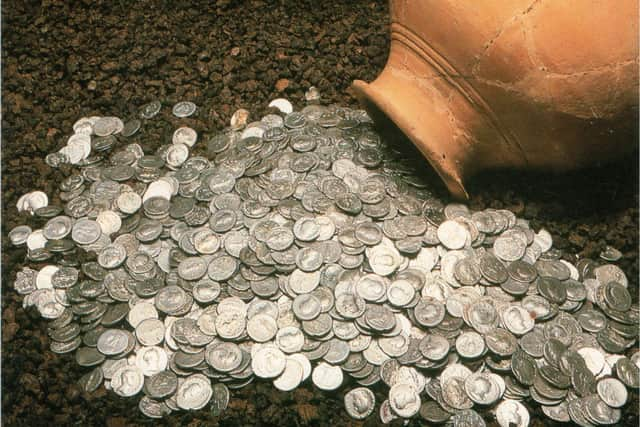
For my third object I am staying with the Romans. The Hoard of 2000 silver Roman denarii dug up by workmen in the Kerse Lane / Callendar Riggs area in 1933 are thought to have been bribes paid to some local chieftain in the Falkirk area to help keep the peace. They were also in an earthenware pot and seem to date to around 230 AD. The coins cover many Imperial reigns. Of lesser importance but of considerable interest was the little piece of brown and cream cross woven cloth dubbed the ‘Falkirk Tartan’. Where are they now? In Edinburgh of course!
My fourth object is a carved Foundation Stone in the foyer of Trinity Church. It is inserted above the door into the body of the kirk. It tells us in rather crudely carved English lettering that the church was founded by King Malcolm III (Canmore) in 1017. Alas for romance, it is almost certainly a forgery put there in 1811 when the present church was built. At the time the Minister Dr James Wilson was involved in a legal wrangle about the age of the church and this piece of evidence made its sudden appearance. I chose it because although it may be a 19th century forgery, the message it bears might very well be true for one of the previous buildings. And it has provoked discussion for years about the early Christian church in Falkirk.
Next week I’ll tell you about my next four choices. Meantime you might like to think of the things that you would include.