
More protests planned against Larbert data centre proposal which applicant says will create 500 jobs
Residents who opposed a hyperscale AI data centre being built in the Larbert area have announced the date of their next protest and a meeting to get their message across.
More than 7000 objections have now been made to the plans for the 300MW data centre through Falkirk Council’s planning portal, with many residents fearing it will bring noise, pollution and traffic to the site, which is next to a care home and close to a major hospital as well as thousands of homes.
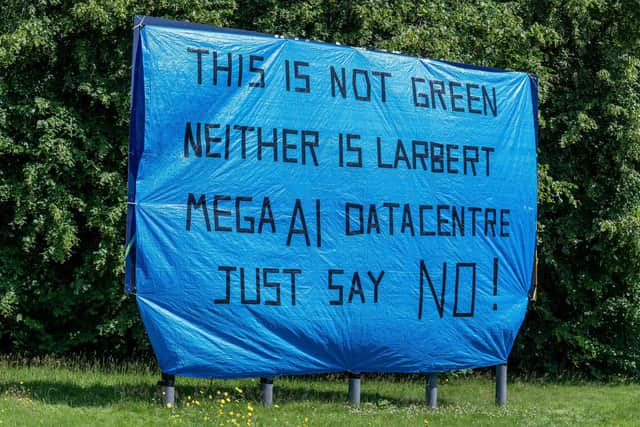
Banners and posters around Larbert and on the development site, beside Glenbervie Business Park on Bellsdyke Road, also show the strength of feeling.
Organiser Hazel McQueen, who lives very near the proposed site, says they want this protest to be “our biggest and strongest yet” as she urges people to attend on Thursday, August 13 at 14 at Glenbervie Business Park.
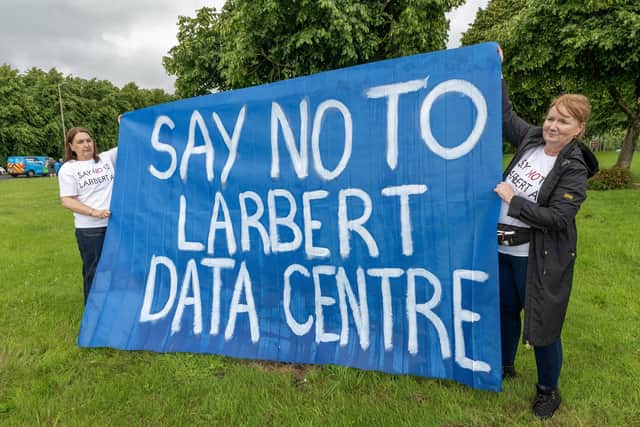

She said: “We’d love to see even more people there, with bigger banners, more signs, and even more community spirit.
“Information leaflets and posters will be available on the day, so please come along, bring your family and friends, and help us send a clear message.”
Renewable energy developer Apatura claims that the project “could deliver close to £1 billion in investment, support more than 5000 construction jobs and more than 1300 long-term skilled roles (including over 500 local positions), and help meet growing demand for secure, low-carbon digital infrastructure”.
But critics have questioned how the investment will actually benefit the local area and have cast doubt on the number of long-term jobs that will be created by the site.

Michael Maciocia, a retired technology worker who has led local opposition, says that most of the money spent on the development will go to American companies that produce the technology needed, which will then be imported to Scotland.
According to Apatura, the employment figures in the planning application are drawn from an independent Economic Impact Assessment conducted by Glic.
A spokesperson said: “The assessment models the operational requirements of a data centre campus of this scale and estimates the range of roles required to support its long-term operation. This includes both on-site and wider supply chain employment.
“The roles identified in the assessment reflect the breadth of functions required to operate and maintain the facility, including engineering and technical roles, security, facilities management, landscaping, cleaning, and other operational support services.”
Apatura claims the development means:
- 515 jobs supported in Falkirk every year, ongoing – 297 of them on site. This includes IT and technical roles, as well as facilities, maintenance, and security personnel. This number includes shift work, so while there would never be 297 people on site at any one time, they would be employed at the facility.
- £306 million per year added to the Falkirk economy – roughly 0.2 per cent of Scotland’s GDP.
- Average on-site salary of £59,977 – 54 per cent above the current Falkirk average of £38,877.
- The apprenticeship levy generated would support roughly 18 apprenticeships during construction and 17 on an ongoing basis.
Mr Maciocia, however, has described the information in the planning application as “marketing BS”, noting that Apatura will not be operating the site and therefore cannot know what will be needed to run it.
“Apatura do not have the knowledge or commitments from others to support any of their claims on employment, partnerships, community programmes. These are just words,” he said.
Other concerns include the 200 diesel generators that will provide back-up power, in the event of a power failure.
Objectors fear the monthly testing alone will release tonnes of nitrogen oxides and nitrous oxide gases annually, placing the facility among major regional polluters.
Apatura says the generators are “industry standard for developments of this scale” although they will continue to explore alternatives “as technology evolves”.
The company adds that testing would be subject to legal limits by environment watchdog SEPA and that this will be reviewed as part of the planning process.
A spokesperson for the company said: “What matters for health is not what leaves the stack, but the concentration that reaches the air at your home, and that is exactly what the air quality assessment accompanying our planning application measures. It models deliberately pessimistic worst-case conditions and predicts the resulting concentrations at the nearest houses.
“The approach proposed for the data centre campus at Larbert is consistent with established practice for critical infrastructure in the immediate area. For example, Forth Valley Royal Hospital, located adjacent to the site, has operated standby diesel generation since 2011, with routine monthly and annual testing undertaken under NHS Scotland technical guidance, albeit at a smaller scale.”
But it is the scale of the proposals that is alarming many people.
Larbert is just one of 24 applications for hyperscale data centres – proposed by various developers – that are currently at different stages of the planning process across Scotland.
While some residents are opposed to the Larbert site simply because of its location, others are worried about the sheer amount of energy that these data centres will consume in the midst of a climate emergency.
Mr Maciocia says that hyperscale data centres should not be confused with current data centres, such as those used by banks, which use a fraction of the power the new AI data centres will consume.
Nationally, there have been calls for a moratorium on all of the developments to ensure that the impact on the environment is fully understood.
Both the developers and the objectors are urging local people to find out more about the plans and what they will mean for the community.
Apatura said: “The project website is available for more information, and we welcome general feedback, along with ideas for community initiatives we could support.”
They added: “While the application is being considered, we are working on the next phase of engagement with community representatives, where we would like to participate in a constructive discussion and address understandable concerns about a development that has been subject to much misinformation and misconception.”
The group ‘Say No to Larbert Data Centre’ says it will continue to campaign to raise awareness of the development, with another public meeting planned on September 10 at 7pm in the Dobbie Hall, Larbert.