
Falkirk Council say 20mph zones are slowing drivers down - and will save lives

Plans to slow down motorists as they travel through built up areas are making a difference, according to Falkirk Council.
Officials say it is making people reduce their speed – with more measures being introduced this autumn to keep streets safer.
In April last year, Airth became the first location in the district to pilot a 20mph speed limit as part of an 18-month trial.
Initial findings show average vehicle speeds have reduced from 26.1mph to 23.1mph following monitoring at 11 locations across the village.
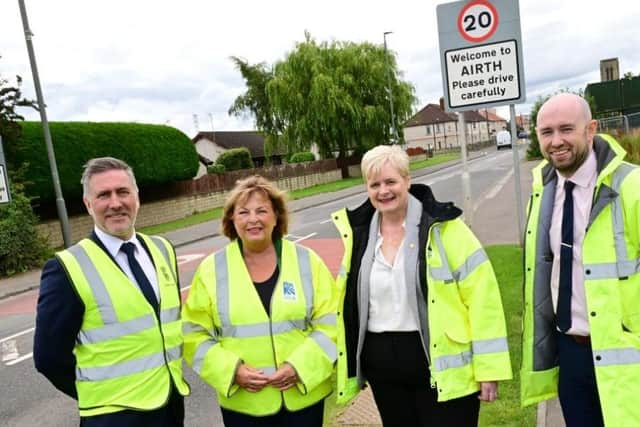

Now to further enhance road safety, more permanent traffic-calming features – including planters and splitter islands at both village entrances – are being designed and will be installed in October as part of long-term infrastructure to support the 20mph limit.
Building on Airth’s success, 20mph speed limits have now been introduced in 16 additional settlements as part of a Phase 1 rollout. These schemes were delivered at a cost of £91,000, with £82,000 coming from Transport Scotland.
The major £800,000 junction upgrade at Snab Brae in Bo’ness has recently been completed, which council officials say significantly enhance road safety and enable active travel.
This scheme connects directly into the National Cycle Network (NCN) Route 76 and includes:

*Permanent traffic signals at the A904/A993 junction to enhance safety for all road users
*A 3m-wide shared footway and cycleway, creating a seamless active travel link
*New pedestrian and cyclist crossings on all approaches
*Drainage improvements to reduce the risk of surface water hazards.
Transport Scotland contributed £250,000 to the Snab Brae scheme through the Road Safety Improvement Fund in 2024/25, with the remaining balance met by Falkirk Council.
Councillor Cecil Meiklejohn, leader of Falkirk Council said: “These road safety measures are a clear demonstration of our priority to improve safety on our local roads and to provide active, sustainable travel options.
“The data from Airth’s 20mph pilot shows that well-designed limits can change driver behaviour, while the Snab Brae upgrade not only addresses a critical safety concern at a busy junction but also links seamlessly with the NCN 76 route to encourage walking and cycling.
“We are grateful to Transport Scotland for their support as we work to roll out further improvements across our communities.
Cabinet Secretary for Transport Fiona Hyslop was a recent visitor to Airth see the work carried out. Afterwards, she said: "Road safety is a top priority for the Scottish Government and we remain fully committed to working with our partners to achieve our ambitious goal of making Scotland’s roads the safest in the world by 2030.
“It’s hugely encouraging to see the positive impact of the 20mph pilot in Airth. We know that reducing speeds saves lives – you are seven times more likely to survive if struck by a car at 20mph compared to 30mph.
“The improvements at Snab Brae in Bo’ness are also very welcome. By making the junction safer for all users, and enhancing connections for people walking, wheeling, and cycling, Falkirk Council is helping to create a safer, more sustainable transport network - including links into the National Cycle Network.
"This kind of investment is delivering real benefits, not only by improving safety but also by encouraging more people to choose active travel. I’m pleased to see local authorities like Falkirk Council leading the way and delivering meaningful change in their communities."