
Carron-made phone boxes receive makeover to form part of new Falkirk area Iron Trail
Three iconic Falkirk district-built red phone boxes have been transformed into ‘time kiosks’.
The K6s, which were originally made by Carron Ironworks, have undergone a makeover and will form part of an Iron Trail devised to remind passers-by of the area’s proud past.
Having become one of the most recognisable symbols of 20th century Britain, the last few existing red phone boxes were saved by Falkirk Made Friends (FMF) last year.
FMF’s restored boxes, which have now been adopted by Falkirk Council, can be found at the newly refurbished Ladysmill Bridge in Falkirk, beside the high flats in the town’s Callendar Park and in King Street, Stenhousemuir.
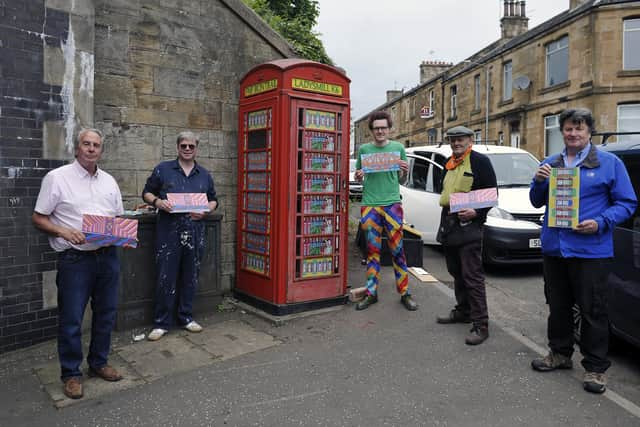

Duncan Comrie, FMF secretary, said: “Each will have original artwork displayed which reconnects with the significant cultural and public health achievements, local, nationwide and international, associated with the products of the Falkirk district cast iron industry.”
To focus attention on Carron Ironworks’ role as the original maker of cast iron phone kiosks, FMF is appealing for the donation of an original K6 phone box to regenerate and locate at the entrance of the site.
The Ladysmill K6 is the first phone box to be transitioned into a time kiosk and among its 76 windows is a graphic colour display of local connections.
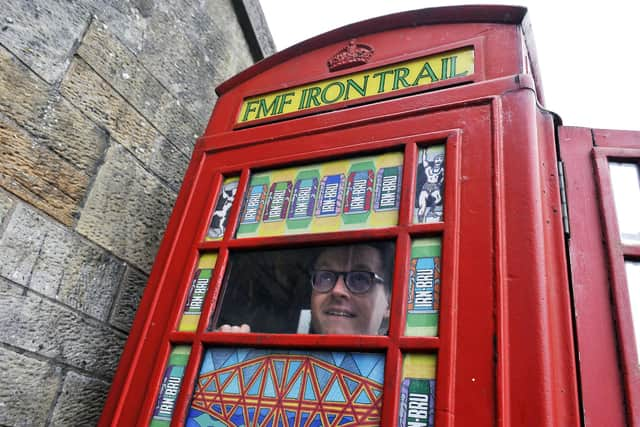
The first of these depicts the Forth Road Bridge of 1964, the architect of which, Sir Giles Gilbert Scott, was also the designer of the cast iron phone box.
There’s also a nod to the Forth Bridge as the maker of Falkirk’s Ladysmill Bridge, PW MacLellan of Clutha Works, was also involved in the construction of what is arguably Scotland’s most famous rail crossing.
The connection is further strengthened by a recent realisation that Barr's Iron Brew was originally created as a tonic drink for the roof workers at Central Station around 1900 – a the station built by PW MacLellan.
Barr's began in Falkirk used to claim that it was the drink ‘made from girders’, yet, according to FMF, “few realise that it was made in an iron town”.
Fittingly, a variety of Barr's imagery frames the three sides of the kiosk.