
Falkirk councillors back road safety plan but want more details on 20mph pilots
A plan to reduce deaths and serious accidents on Falkirk’s roads over the next five years has been given the green light by councillors.
But members of Falkirk Council’s executive have also asked for a future report on the success of 20 mph limits that are being introduced as part of the measures.
Pilot schemes are currently running in Airth, Allandale and Stoneywood and while they have been generally welcomed by residents who have long been concerned about speeding, there are also some questions about how effective they are.
The SNP administration’s motion – which incorporated Labour and Independent amendments – asked officers to report back to a future scrutiny committee with updated information from the pilot schemes.
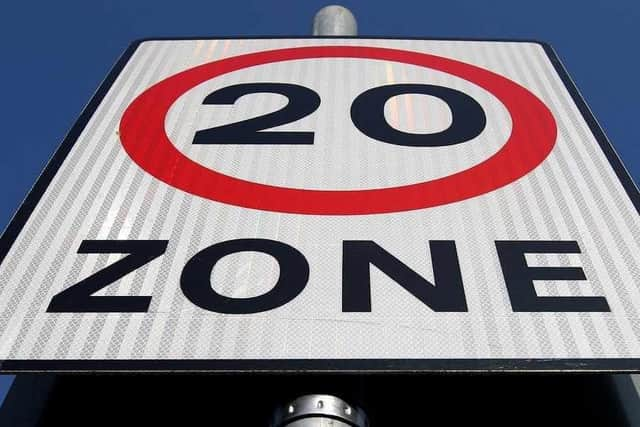

Councillor Laura Murtagh, whose ward includes Airth, where the first speeding pilot was introduced, said the issue was important to discuss as the results of 20mph were not straightforward and full data analysis is needed.
The Airth pilot has shown that there has been a reduction in the average (mean) speed that drivers are doing but there is still no overall compliance with the 20 mph speed limit.
Labour councillor Jack Redmond said he wanted to see the report on 20mph limits going to the scrutiny committee as some Allandale residents have raised concerns about their introduction.
“We hear that they are regularly being ignored and even more worryingly, the lower speed limit has led to dangerous overtaking,” he said.
“We thought it was important to bring that forward and we welcome the collaboration today.”
Studying the data from the 20 mph areas will allow the council to consider whether it might be better to make changes, such as reducing or shifting the extent of the speed limit.
If compliance is low, they may need to consider other speed management measures or accept that the road is not suitable for a 20 mph.
Conservative councillor James Bundy asked if there was genuine community buy-in before 20 mph were introduced.
He was told that there had been community consultation and while the response had been low it was “generally positive”.
But there was praise for the ongoing work to improve road safety across the council area and acknowledgement that the number of collisions has significantly reduced over the last ten years.
Conservative group leader, Baillie James Kerr, said that recent work on Cadgers Brae had made a huge difference to constituents and he hoped more such projects could be identified.
The report pulled together up-to-date statistics available to the council from Police Scotland, along with traffic survey data and local knowledge.
SNP councillor Paul Garner, said the wider approach in the report provided a more “proactive approach to road safety” and helps it align with national targets.
The data shows that young motorcycle riders, adult cyclists and schoolchildren are all vulnerable and the report looks at ways these groups can be targeted to make their travel safer.
By 2030, the hope is that actions contained in the plan will see the overall number of people being killed and seriously injured on the roads reduced by half, with a target of a 60 per cent reduction for children under the age of 16.
The figures recorded by Police Scotland show that driver error remains by far the most common factor where collisions have happened.
In the years 2013-2024, the figures show that ineffective observation by either the driver, rider or pedestrian was at the root of 834 accidents; the driver/rider being aggressive, dangerous or reckless was responsible for 273; and the driver/rider travelling too fast for conditions (including loss of control or swerving) 235 collisions.
Education, particularly aimed at young drivers, will remain a priority for the road safety plan, with local schemes such as Safe Drive Stay Alive and Biker Down being promoted alongside free online classroom resources available from Road Safety Scotland.