
Remembering Rosebank distillery as it prepares to reopen in Falkirk on edge of Forth & Clyde canal
Among those eagerly awaiting the reopening of Rosebank on June 7, is David Robertson, a veteran of the whisky trade who has fond memories of the old distillery.
He has worked for The Macallan and The Dalmore and went on to co-found Rare Whisky 101 in 2014 and the Holyrood distillery in Edinburgh five years later. But he began his career in 1990, after studying Brewing & Distilling at Heriot-Watt University with Rosebank’s then owners, United Distillers, now Diageo.
David was part of a small process support team in Elgin whose job was to visit the 30 or so distilleries owned by the company to help try and resolve any production problems there might be. This took him to Falkirk a couple of times before Rosebank closed in 1993.
“The distillery manager at the time was a man called Sandy McKerrow who was a wonderful old-school distiller,” he says.
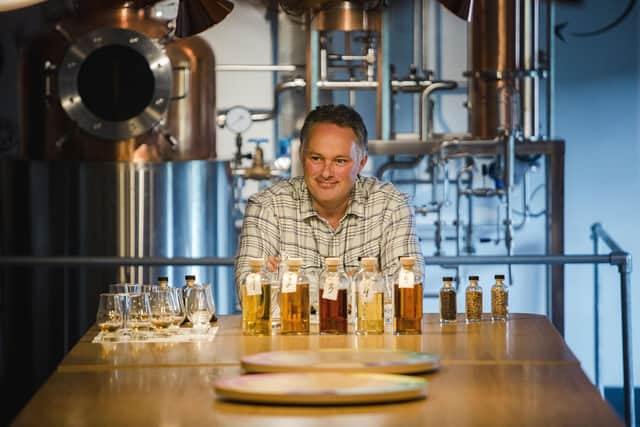

“He was a really nice guy, and I remember shooting the breeze with him about how they used to make whisky back in the good old days, and we talked of some of the challenges he was facing at Rosebank, like getting raw materials in and by-products out, and dealing with water. My recollection was that the mashing and fermentation side of Rosebank was pretty traditional, with the fascinating and unique difference being that it was triple-distilled.”
The challenges mentioned by McKerrow were part of what led to the distillery’s closure a year or two later, though in many ways it simply fell victim to an industry-wide slump. The vast majority of Rosebank whisky disappeared into bottles of blended Scotch of which there were too many on the market in the so-called ‘whisky loch’ years.
Single malts were just starting to take off, and as David recalls: “In the early 1990s in Scotland I’d probably only have seen Glenfiddich, Glenmorangie and The Macallan in a bar. That would have been about it, with the big blends like Famous Grouse, Bells and Whyte & Mackay on the optics. The choice was incredibly limited back then.”
Every Friday, while working at United Distillers, he and the team would nose all the newmake fillings – the clear, unaged spirit fresh from the still from all the distilleries.
“I think Rosebank was always a pretty good spirit – it was light, floral, fruity and citrusy,” he says.
Sadly, he never kept a sample, for it would be fascinating to compare it to the new Rosebank spirit that has been in production since last June.
Over the years, he has “been lucky enough to sample and collect numerous bottles of Rosebank,” and through his Rare Whisky 101 consultancy, he has watched its value and rarity steadily increase.
“Absence, can often make the heart grow fonder,” he says of demand for whiskies from these ‘silent distilleries’.
When he heard the news in 2017 that Rosebank was to be rescued, he was “absolutely thrilled to bits”.
Before then, whenever he had driven past the old distillery, he says: “I never imagined that anyone would be in the fortunate position to bring it back to life. I think it was a stroke of genius for Ian Macleod Distillers to have struck a deal to acquire Rosebank and a limited amount of mature stock.”