
Remembering Falkirk man's exploits with 51st Highland Division in WWII

A Larbert woman has recently returned from walking in the footsteps of her soldier father and his comrades who were deployed in France during the early days of World War II.
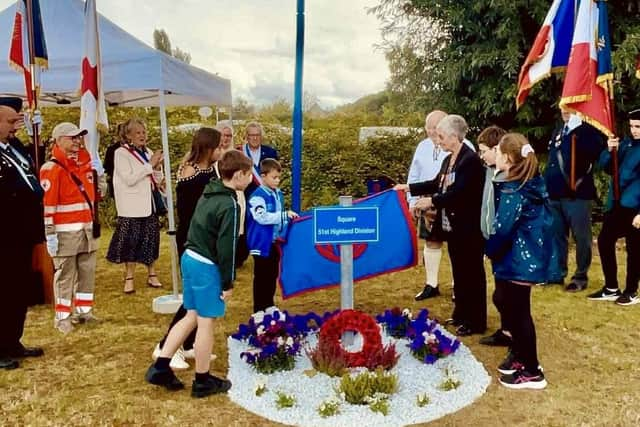
Isabella Patterson was also given a central role in the dedication of the memorial garden to the 51st Highland Division who fought to protect the French people as part of the British Expeditionary Force (BEF)
Her father, Samuel Patterson, was aged 27 and a gardener locally when he went to France as part of the 7th Battalion Argyll and Sutherland Highlanders, a Territorial Unit mobilised in 1939 which embarked for France along with the BEF in January 1940.
The Argylls were drawn from the communities of Falkirk, Stirling and many other towns in the area.

In early June 1940 the 51st were engaged in three major battles: the Battle of Abbeville, Battle of Franleu and the Battle of St.Valery-en-Caux.
Isabella’s husband, Stephen, who accompanied her to France, explained: “Marieul-Caubert village was central in the Battle of Abbeyville with close combat action taking place in the village and surrounding area.
“The village of Franleu was the pivotal point and HQ of the 7th Battalion Argylls during the Battle of Franleu with action being undertaken in that village and surrounding villages.
"St.Vallery-en-Caux was the final battle of the 51st Highland Division in 1940.”

An extract from the Battalion’s war diary reads: “All day long on the 6th of June we were subjected to bombardment and attacks, and this continued throughout the following day, the 7th of June, until the evening, when ammunition was exhausted, and with more than 50 per cent, casualties Major Young had no alternative but to surrender.”
Samuel and many of his comrades in arms were taken prisoner and he was to spend the next five years as a prisoner of war until he was finally released on May 13, 1945, days after the war in Europe had been won by the Allies.
He had been interred in various POW camps in Germany and Poland, including the infamous Stalag Luft 3 which featured in the film The Great Escape. On his release and return home he weighed just six stone (38kg).
Samuel found a very different world when he came back to the Falkirk area. Sadly his wife had died while he was a POW and his two children, aged just five and one when he went to war, had been cared for by their maternal grandparents and didn’t know him. His own father had also died months before his return.
The family had lived in Taylor’s Buildings in Larbert but the house had been emptied while he was gone and he had no home to return to.
He met his second wife, Frances Gallacher, in 1946 and married in Camelon that year with their only child, Isabelle born in 1948.
Samuel became a postman, a role he carried out for almost 30 years until he was medically retired in 1975, dying a few months later.
Isabella grew up knowing of her father’s Army exploits but she wasn’t the only one to hear of their courage. Stephen added: “The French people have never forgotten the gallant stand and sacrifice made by the 51st during the Battle of France in 1940 and memorial spaces and streets in towns and villages carry the 51st Highland Division name.”
The couple were invited last month by the France 40 Association to take part in the dedication of the 51st Highland Division Memorial Garden.
Provost Robert Bissett kindly gave them Falkirk Shield and a framed portrait of himself to present to the Mayor of Marieul-Coubert, along with a letter of appreciation for all the work done in preserving the memory of the 51st Highland Division.
Stephen said: “It was an emotional journey for us all and particularly for my wife being in the exact places her father had been so many years previously.
"She was given a prominent part to play in all the proceedings and assisted in the unveiling of the Memorial Garden Space along with young people from the village.
"A truly memorable event.”