
Looking back with Ian Scott: Walking the historic route of Falkirk's electric trams (part one)
A few years ago I dedicated this column over a few weeks to a historic walk round the seven and a half miles of the old circular route, following the electric trams which ran from 1905 until 1936.
Now with the sun appearing at last I thought it a good time to revisit this as a suggestion to all those walkers who like me prefer taking their exercise in the town rather than the country. So here goes for the first stretch.
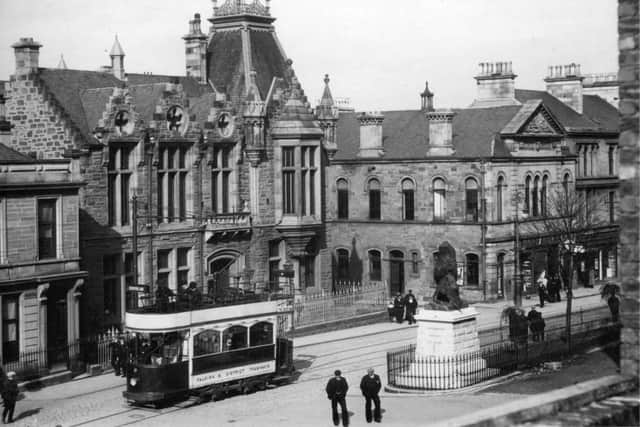

I started outside the old Burgh Buildings in Newmarket Street where the trams began their journey in both directions. The building opened in 1880 as the first purpose built home for councillors and is still in good nick 145 years later! Heading west between the old Sheriff Court (1870) and West Church (1799) is the Tanners’ Brae, a reminder of the days when Falkirk had several leather works, this one drawing water from the West Burn now piped beneath the road.
Other old activities are preserved in the names ‘bleachfield’ and Kilns House once home to the Victorian Procurator Fiscal John Gair. Another prominent lawyer, James Russel, lived at Arnotdale, set within park land now named after Robert Dollar the Falkirk born philanthropist who gifted it to the town in the early 1920s. The Peking lions at the gate came from the Emperor of China with whom Dollar, whose ships sailed from San Francisco, had strong personal links. The War Memorial fronting the park was unveiled in June 1926 to honour the 1160 men who fell in the Great War.

Approaching the canal the skyline is dominated by the chimney of the recently restored Rosebank Distillery where tripled-distilled Lowland malts were produced from the 1840s. If you have a bottle hang on to it!
Over the canal and we are officially in Camelon. Since I have written about the village quite often I will give it a body swerve and plough straight on to the Roman Bar where the trams turned northwards towards Larbert.
Falkirk Golf Club’s course on the left beyond the railway was designed by the famous James Braid in 1922 and covers ground once occupied by the Romans and later the miners of Carmuirs Colliery. The nearby bus depot still uses the red brick buildings constructed to house the trams in the 1930s and across the road a path leads to the new Dorrator Bridge which replaced the good old ‘swing bridge’ of 1893.
Back to the main road and on past the incorrectly named ‘Larbert Mill’ building which has been beautifully restored as a dance studio. There are three bridges crossing the river here. The old one built in 1780, the modern one from 1926 and the 15 arches of the 1848 railway viaduct which was the scene of a famous rail crash 20 years later in which hundreds of cattle and sheep were killed.
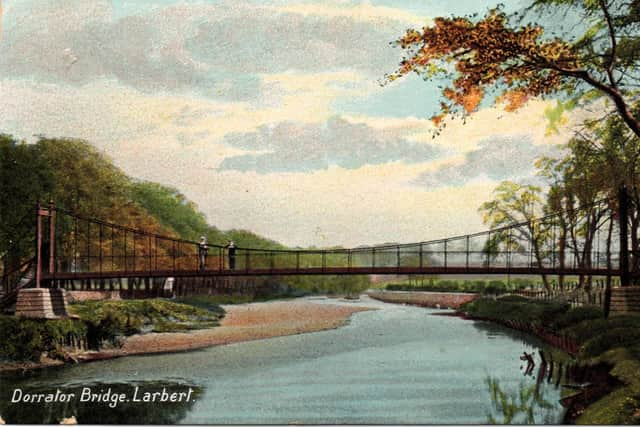
Through the viaduct and up the hill past the place where the Scottish Army’s guns fired over the river towards Oliver Cromwell’s soldiers in 1651. On the left Larbert Old Parish Church designed by David Hamilton in 1820 stands surrounded by the graves of men of distinction like Rev Robert Bruce, his descendant James Bruce the Abyssinian traveller and the mighty men of Carron Company.
Time to take a break. The choice is simple, the Commercial for a pint or a walk round the historic graveyard. Though sorely tempted I chose the latter. Fewer calories.
For the second part of Ian Scott’s walk click here.
Part three – from Carron to Grahamston – can be found here.