
Looking back with Ian Scott on the history of the Falkirk area's doocots
Some years ago I visited one of our local primary schools to talk to the children about Callendar House.
I showed them a photo of the doocot on the old stable block and asked why people used to keep pigeons. One lad offered “To race them against other people’s birds”. Another said “ To carry messages tied to their legs”. Finally one of the girls said “To eat them!”.

This was greeted by all the class making sick noises and shouting “Yuk” or “Ugh” etc. They had not yet discovered the pleasure of a wood pigeon casserole which was a very important part of our forefathers’ diet. In fact almost every mansion house in Scotland had either a purpose built pigeon house or dovecote (doocot in Scotland) or had one adapted within an existing building for the purpose.
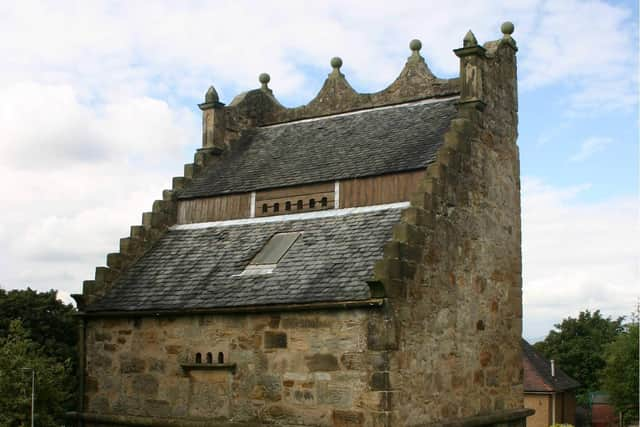
Quite a few of them are still to be found in our area though many are in a poor condition due to neglect or vandalism. Some have fared better than others and the finest example without a doubt is at Westquarter where the magnificent lectern style building has survived the demolition of Westquarter House in 1933. It bears the date 1647 and the intitials WL and HL for Sir William Livingston and Lady Helenore his wife. It has been restored and is protected by an A listing from Historic Scotland. It has spaces for nearly 900 birds.
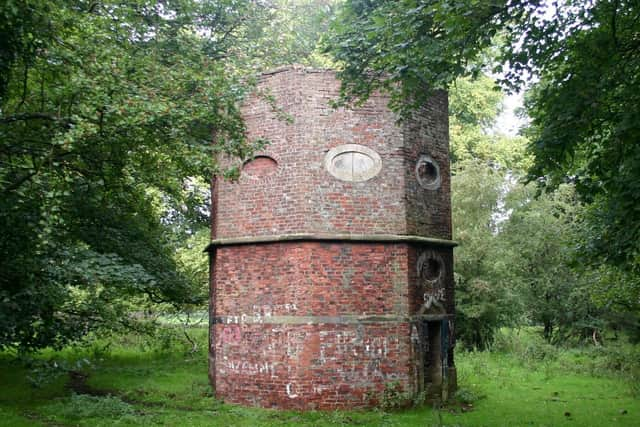
Not so well preserved is the interesting tall octagonal shaped red brick doocot close to the ruins of Carron House in Carronshore. This Georgian structure had room for over 1000 birds and despite its B listing has lost part of the top sandstone cornice and is at high risk of further deterioration.
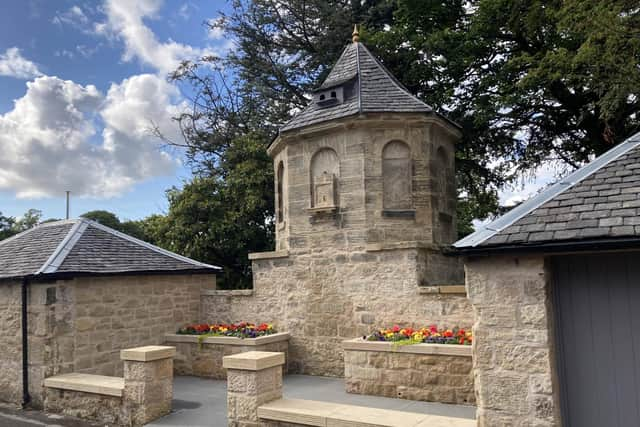
Perhaps the best know of the doocots in the Falkirk district stands behind Arnotdale in Dollar Park. It was built at the same time as the house around 1834 by the lawyer and man of business James Russel and is still home to a few white doves introduced in more recent years. It was also in a poor state but thankfully the Friends of Dollar Park campaigned with the Council to have the building restored a few years ago and I must say those responsible made a beautiful job of bringing it back to its original condition.
Parkhill House in Polmont has a nice example of the square Gothic style doocot which looks a bit like a small castle. Unfortunately it is hemmed in by housing and is also badly in need of some care and attention.
There are others like the one at Muiravonside, also lectern style and the mansion house at Avondale close to the landfill site has a doocot set above the arched passageway through the farm buildings on the approach to the house. Unfortunately we do not have an example of the beehive style which is a pity but there are magnificent examples not too far away in Linlithgow and Corstorphine.
Back in 1991 Geoff Bailey compiled an Inventory of local doocots and calculated that at one time or another there had been no less than 53 in Falkirk district of which only 13 were still standing. If we are not careful then this number will continue to decline and we will be the poorer. They may not be castles, churches or fine municipal buildings but they help us understand an important part of our heritage and deserve to be protected.