
Looking back with Ian Scott on the history of Carron's pillar boxes and telephone kiosks
Yesterday morning (Wednesday) the indominable Dr Duncan Comrie was host to a special event at Carron to mark the acquisition for the town of one of the famous K6 telephone boxes which helped bring the name of Carron to all parts of the country and beyond.
I can testify to this international spread – not many years ago I was in Malta taking in the sights including the fantastic domed church in Mosta, surely one of the most beautiful anywhere in Europe. It is a design masterpiece both inside and out but I had eyes only for the red telephone kiosk tucked away in the corner to the left of the building. Closer inspection revealed the message ‘CARRON, STIRLINGSHIRE’ – another little piece of Falkirk 1500 miles from home. I wasn’t surprised because I had already spotted a pillar box in Valetta marked ‘McDowell and Stevens, Falkirk and London’ as well as kiosks all over the place.
The first pillar box in Britain was erected in Jersey in 1852 followed three years later by six in London. Various designs were tried including hexagonal pillars before the classic cylinder became the settled version. It survived until modern times and is by a long way the most familiar.
Carron were early in the business with contracts from the Post Office as early as 1860. Over the years tens of thousands were cast and finished in Mungal Foundry’s Structural Department.
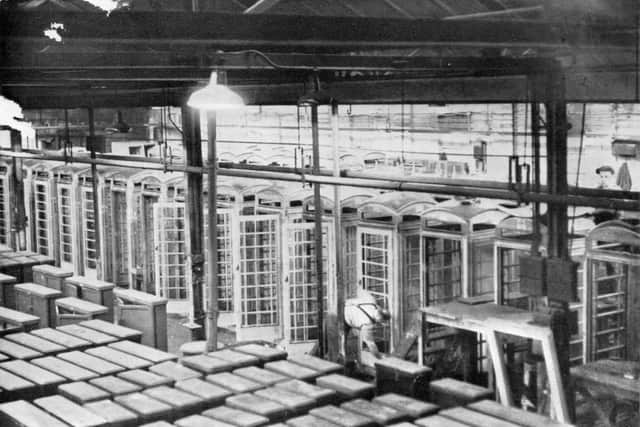

The evolution of the classic telephone kiosk was a more convoluted process beginning around 1900. Several weird and wonderful designs were produced including some with thatched roofs to suit rural and seaside views, and others with domes to help them blend in with historic places. There were even concrete versions.
Some incorporated letter boxes and stamp machines but by 1924 the Post Office had taken the decision to stick by an agreed standard design in cast iron.
Three architects were invited to tender: Sir John James Burnet (educated at Blairlodge in Polmont) and Sir Robert Lorimer were not successful as the Fine Art Commission chose the submission of Sir Giles Gilbert Scott. Give or take a tweak or two his design remains the one we all recognise.
A decade later the same architect made some modifications and the Post Office adopted red as the universal colour of what was named the ‘Jubilee’ kiosk to mark the 25th year of George V’s reign. The inside mechanism with buttons A and B appeared and few folk of my vintage will forget the process of making a call from one of these boxes. Put in your money (a few pennies as I remember) dial the number and when the other person answered press button A to connect. If there was no reply, press button B and your cash came clattering down. Sometimes if you were lucky you got back more than you had put in though it often happened the other way! It was frustrating for sure but most folk had no other choice.

Carron turned out thousands of these kiosks and today they are very collectable as ornaments. If you fancy a piece of history then there is a refurbished one going on ebay at the moment for £7800 and a battered old thing for £1500. Get bidding!
If you are unsuccessful you can always pop down to the former Carron Phoenix works and see the newly unveiled kiosk displaying various Carron Company information.
Thank you Duncan and your colleagues in Falkirk Made Friends.