
Looking back with Ian Scott on the history of Airth
On Monday this week I had the pleasure of visiting the village of Airth to talk about the fantastic history of the area. It is quite a while since I wrote about this subject and I am happy to revisit it today.
Five centuries ago the village was one of the most important centres of military ship-building in Scotland. It was the location of the lost dockyard of King James IV in the late 15th century and here many of the great wooden ships of the Scottish Navy, the ‘Margaret’ and the ‘James’ and maybe even the famous ‘Great Michael’, came to be fitted and repaired safe from enemy attack.

By then Airth had been an important port for several centuries and was even a Royal Burgh in the 1100s though for some unknown reason that status was removed in the following century.
At that time the village sat high above the carse on land to the north of the castle and kirk, which is now occupied by expensive modern housing.

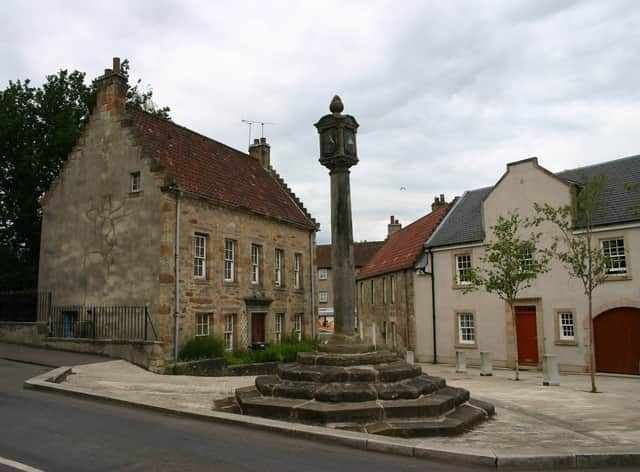
The extraction of coal and making of salt, as well as agriculture and fisheries, brought prosperity to the village and in 1597 it was made a burgh of barony. The sign of this new prosperity was a mercat cross which survives as a stump of a stone shaft known not surprisingly as ‘the heidless croce’.
Airth Castle itself is the latest in a series of buildings starting with a wooden structure supposedly damaged by William Wallace in 1298 in a successful attempt to free his uncle, the priest of Dunipace.
A later castle was destroyed after the defeat of King James III at Sauchieburn in 1488 and the present building dates to around that time.
In the early 19th century the architect David Hamilton, who designed Falkirk Steeple added a triangular block, now the familiar grey face of the former hotel. This created a kind of gothic ‘castle’ with round towers at each end and a central range with turrets and a grand doorway. Sadly the recent destructive fire, vandalism and neglect has dealt the buildings a serious blow.
To the east of the castle is the old ruined kirk with parts dating to the 12th century. It has three aisles, Airth (c1480), Elphinstone (1593) and Bruce (1614) and a later square tower.
There are several interesting grave inscriptions inside the church and many grave markers in the graveyard including cast iron ‘mortsafes’, large coffin shaped containers used to thwart the plans of the body snatchers in the early 19th century. Unfortunately access to the building is now restricted for safety reasons.
Towards the end of the 17th century the population began the move from the high village to the lower ground next to the river.
The harbour was much closer to the foot of the hill but this was followed by extensive land reclamation in the 18th and 19th centuries.
A second mercat cross dated 1697 was placed in the new High Street and, with a thriving trade especially in coal, the port flourished.
There are many fine houses in the village from the 18th century and earlier but the construction of the turnpike road from Falkirk to Stirling in the early 19th century, now the main street, destroyed the original layout of the town.
A new church was opened in 1820 and the original kirk on the hill was abandoned to the elements like the rest of the high village.