
Looking back with Ian Scott on Falkirk area buildings that are not all that they seem
In 1803 the architect David Hamilton (of Steeple fame) added the mock frontage to the medieval Airth Castle creating what is now the recognisable face of the hotel. This got me thinking about buildings that are not quite what they seem and there are quite a few in the district not including all those churches that are now pubs, funeral homes or private houses.
Take the familiar Bridgeness Tower to the east of Bo’ness. With its crenellated top it looks for all the world like a castle rising high above the surrounding village and overlooking the Forth. In fact when it was built back in the early 18th century it was a windmill grinding corn or pumping water from the coal pits. Unlike the familiar Dutch variety our windmills had round stone bases with wooden superstructures on which the sails were mounted. Once abandoned, the wood perished quickly leaving a stone ‘tower’. The Bridgeness windmill was purchased by a shipmaster called David Stevenson who turned it into a house and outlook tower. His initials and those of his wife are carved on a door lintel with the date 1750.
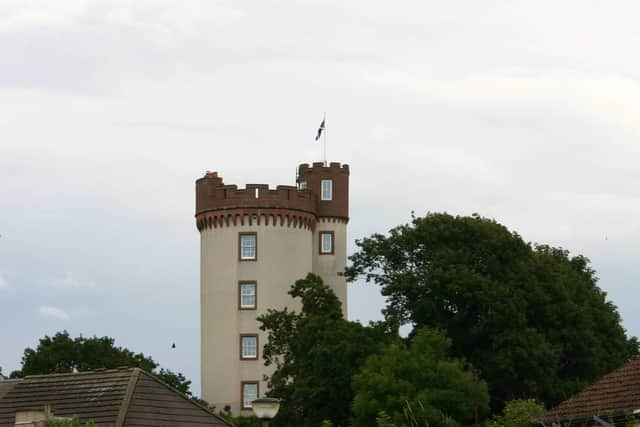

The following century the Cadell family of Grange, land owners and coal masters, installed a sophisticated six inch telescope costing over £1000 to create an astronomical observatory. In 1895 an architect with the amazing name of Hippolyte Blanc remodelled the building for Henry M Cadell extending it upwards and creating the castle features including the stair tower within a small additional turret. After this the tower had a chequered history with families living in each of its five floors but by 1950 it was empty. It was eventually restored as part of a housing project in 1988 and since 2002 has been a private house, surely one of the most interesting in Scotland.
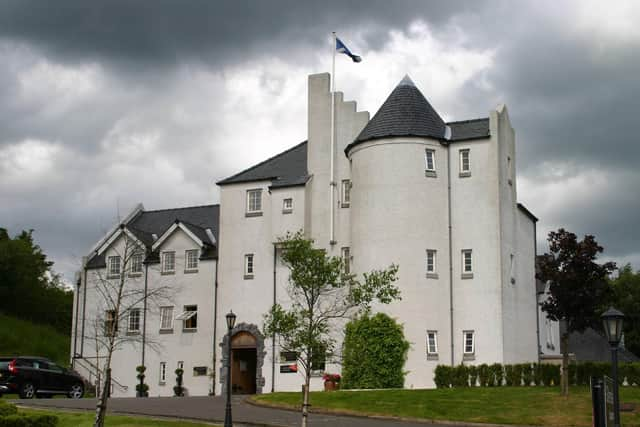
At the opposite end of the district in Banknock stands Glenskirlie House a very popular venue for wedding receptions. One of the attractions is a fine Scottish ‘castle’ with all the external features of fortified tower house of the 15th or 16th century. However it was built from scratch in 2004 as an annexe to the established hotel and restaurant. Another building that has always fascinated me is the Town House in Denny. It looks like a typical Victorian public building in the popular Scottish Baronial style. In fact it was only built in 1931 as a home for the town council of Denny which was abolished back in 1975. The building was on the market recently and may already have been sold.
Finally in Falkirk we have the Tudor House which, as the name implies, reflects in its outside appearance the half timbered buildings that Henry VIII might have patronised. Sadly, as most folk know, the former restaurant dates back to the 1930s when the new Princes Street was cut through towards Callendar Riggs. Most of the other new buildings in the street are of their time, that is Art Deco style, but the good old Tudor House was a throw back to a time that never was!
I suppose we could also include the former York Café which is also an echo of a different place and time though intriguingly behind the mock Tudor façade lies one of Falkirk’s oldest buildings, indeed the only one left with its gable end facing the main street, which was common in the medieval period. The truth is in there if we dig deep enough.