
Looking back with Ian Scott on a golden age of Falkirk clockmakers
A year or so ago I was sent a photograph of a clock which had appeared in a Fife auction house.
It had the name Peter Kier of Falkirk on the dial and my contacts wondered what we knew about this particular clockmaker. The answer is not that much but it reminded me that before Falkirk was the iron centre of Scotland it was famous throughout the land for the quality of its clocks and barometers many of which are in private collections and of considerable value.
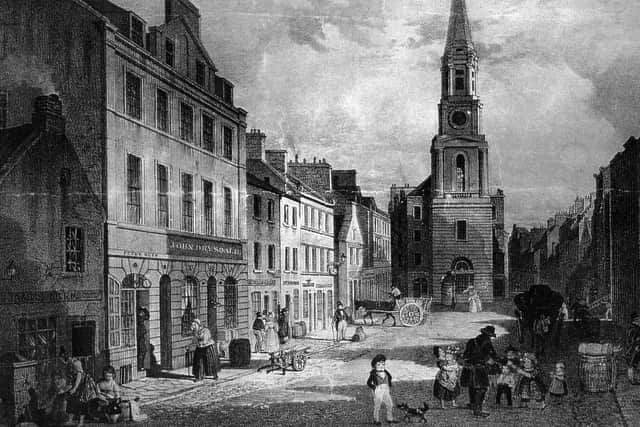

Peter Kier was one among many but his name is preserved in a fine engraving of Falkirk High Street from around 1830 which shows the man himself outside his shop looking up at the steeple and setting his watch.
Peter was active in the town from the early 1800s until his death in 1834. His son Robert was a very scholarly young man who wrote a history of Falkirk but died at the age of 20 in 1827.
One of Peter’s clocks in our local museum is decorated with a colourful image of Wallace killing the Sheriff of Lanark!
By contrast we know a great deal about Peter’s illustrious predecessor John Russell who is far and away the greatest of the Falkirk clockmakers and one of the most celebrated in Britain.
John was born in Dennyloanhead in 1745 and at an early stage showed a great aptitude for mechanics which led him into the manufacture of precision instruments like clocks, thermometers, organs and barometers.
He set up business in Falkirk in the late 1760s and soon established himself as the foremost local craftsman. He was particularly adept at producing musical clocks and this no doubt brought him to the notice of the great and the good.
Around 1790 he was appointed ‘Watchmaker in Scotland’ to the Prince Regent later presenting King George III in person with a specially made barometer and the Prince with a ‘gold chronometer’. Another of his barometers went to Tsar Alexander of Russia.
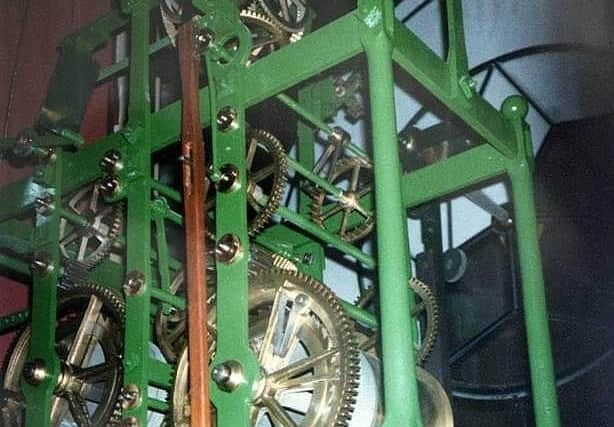
Back home he was engaged by the Stentmasters (of whom he was one) to repair the old steeple clock and when they decided to build a replacement steeple in 1814 he supplied a new clock which served for over a century until 1927. Today it is in the National Museum of Scotland in Edinburgh while his clocks and other devices can be found in Buckingham Palace, the Victorian and Albert Museum, Callendar House and many private houses throughout the district and beyond. A couple of years ago one of his ‘royal barometers’ raised over £10,000.
John Russell died aged 72 in 1817 and his place as Falkirk’s leading clockmaker passed to William Dobbie who had been Russell’s main competitor. Four generations of the Dobbie family were active clockmakers in the area and William who was the third was successful enough to be named as Watchmaker to Queen Victoria and have his work displayed in the 1851 Great Exhibition in Crystal Palace.
Falkirk craftsmen from the mid 18th century include William Callander whose shop was in Manor Street, John Galbraith, James Hendry, Robert Warden and Robert Dalgleish but there were many more.
It was a golden age for this particular craft and I will never stop being amazed by the precision engineering skills, intricate cabinet making and beautiful decoration that make the work of these master craftsmen such a triumph in an age before electricity, power tools and other modern aids.