
Looking back with Ian Scott as a new book is published on the 1746 Battle of Falkirk Muir
In 1769 an English traveller called Thomas Pennant visited our area. In his Journal he noted that there had been many battles in Falkirk district and added “for the Scots had they no public enemy to contend with fell to fighting among themselves”.
He was clearly referring to the battle fought 20 odd years before on the lands of South Bantaskine where Prince Charlie’s Jacobite army defeated the Government forces commanded by General Henry Hawley. This was part of a Civil War with huge number of Scots in red coats facing their fellow countrymen.
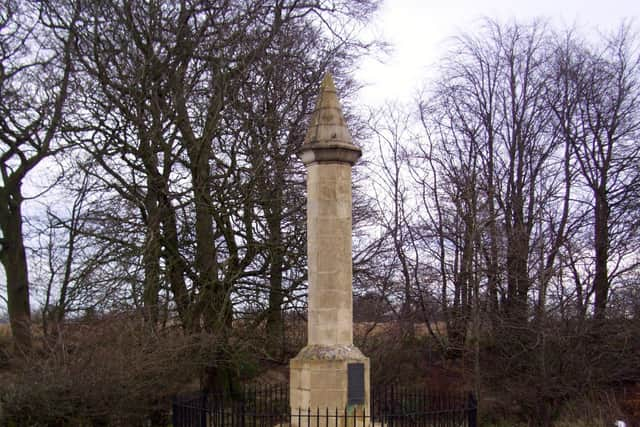

The Battle of Falkirk Muir as it is known was the second and biggest clash of the Rising, much bigger in terms of soldiers engaged (around 18000) than either Prestonpans or Culloden. It was also the last time the famous Highland charge drove the enemy from the field.
For us in Falkirk it was obviously especially important as an important part of our local history – not only because of the battle itself but because after the victory the Jacobites remained in the town and district for 11 days before moving north to their final defeat at Culloden.
Now we have a new extended book by Geoff Bailey which like his 1996 publication is called Falkirk or Paradise. The Battle of Falkirk (1746) Trust has published the book along with Falkirk Local History Society.
The Trust Chairman Rod Tulloch has been an enthusiastic collector of Jacobite memorabilia and over recent years he has led a campaign to create a centre up in South Bantaskine to tell the story of the events of 17th January 1746.
As far as the clash on that day is concerned, it lasted a mere half an hour in foul winter weather with the Hanovarian Dragoons and Infantry struggling up the hill from the Dollar Park area to confront the massed ranks of clan warriors supported by the men of the Lowland Jacobite families. Some locals were recruited to haul the Government cannon up the hill but when they stuck in the mud the gallant ‘bairns’ ran away leaving the ordnance where it lay!
Geoff describes the way the battle unfolded using a host of eyewitness accounts some of which he has uncovered in his extensive research. In short the right wing of the Jacobite army drove the dragoons back in disarray and though the Redcoat infantry on their own right did manage to advance the battle was lost. We learn that immediately after the battle Lord George Murray in command of the Prince’s troops was fearful that as they entered the town of Falkirk they might face a big ambush. But since the weather was so bad and they were short of provisions he gave the order to move forward with the words “Tonight we will either lie in Falkirk or Paradise” hence the name of the book.
Geoff also explains in detail the background to the Rising and the aftermath of the battle in the town and district. The role of Lady Ann Livingstone and her husband William Boyd, 4th Earl of Kilmarnock, then resident in Callendar House, are covered as well, including his beheading on Tower Hill for treason along with other Jacobite Lords.
The book is 360 pages, hard back with over 160 maps, photographs and other illustrations mostly in colour. Many of these are images of Rod Tulloch’s collection of memorabilia. It is available from the History Society by contacting me on [email protected]