
'Power surge' during Storm Eowyn caused Forth Valley Royal Hospital blackout
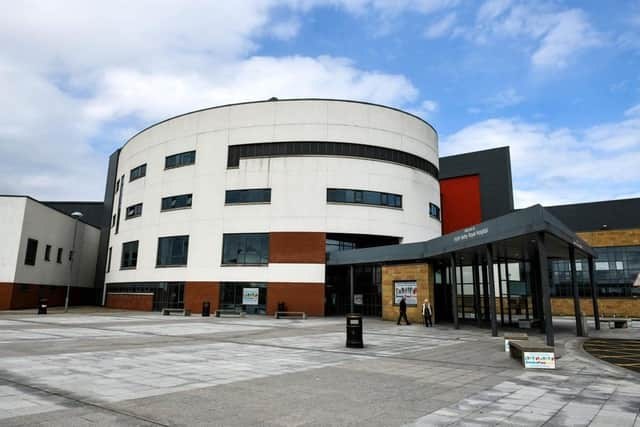
A complete power failure in Forth Valley Royal Hospital at the height of Storm Eowyn was caused by a surge in power as back-up generators ran alongside grid power, it was revealed this week.
Bringing a report on the incident which occurred two months ago to NHS Forth Valley’s board, director of acute services, Garry Fraser, stressed to members that vital equipment including ventilators all have back-up batteries to provide uninterrupted power and no patients came to any harm during the incident.
The power outage at the Larbert hospital happened at 2.45 pm – around the same time as the severe weather caused all telephone lines, including mobiles, and WiFi to go down.
Presenting the results of an investigation into the issues, Mr Fraser told the board that the storm on January 24 had caused dips in power across the site earlier in the day.

The fluctuating power caused minor disruption – with lights flickering and several circuits and systems having to be reset – so facilities company Serco took the decision to run the hospital’s generators alongside the mains power supply, in a bid to keep the power running as the storm got worse.
Mr Fraser told the board members that this is generally seen to be “good practice” but at 2.45 pm, there was a major surge which caused both mains and generator power to fail.
At the same time, the telephone exchange was offline due to weather which coincidently resulted in a complete loss of communication, lighting and even running water in some areas, where taps need electricity to function.
Mr Fraser said there was an “immediate response” from Serco and from the hospital’s management team to restore power as quickly as possible.
There was particular concern about the Emergency Department but Mr Fraser assured members that ventilators have a three to four-hour battery back up.
The report stressed no patients required to be manually ventilated as a result of the power loss, contrary to some initial media reports.
“This was something we were very focussed on. There was no drop in continuity of care to any patients,” he said.
An emergency command structure was already in place in response to the red weather warning and Mr Fraser says the response of staff on-site was “exceptional”.
“I really do need to highlight the exceptional staff working – people were willing to do whatever they had to do for us to get through this.”
After the incident, a de-brief looked at what had gone wrong and how this could be improved.
Serco have reviewed their standard operating procedures and said they will avoid running the generators along with mains power.
Mr Fraser said that there will also be clearer plans to take action more quickly on what should be rescheduled in the event of a red weather warning.
Phone and WiFI issues were due to power outages at local masts as well as power outages at the local exchange due to the severity of the storm.
Members heard that communications were maintained in an “old-school” way by having meetings every 30 minutes with “runners getting their trainers on” and taking a notepad.
Overall, however, Mr Fraser said the response from staff had been “really good”.
“We will review our continuity plans but the ones we had in place did work well for us.”
Chief executive Ross McGuffie said that the learning from the events had been crucial as power loss is one of the highest risks faced by the health service nationally.
But while he acknowledged there were improvements that can be made, he said the emergency procedures had been followed “incredibly well”.
The chair of the board, Neena Mahal, also praised all of the staff involved for “stepping up and making sure no harm came to patients”, including partner staff working in communities.