
FVRH faced 'challenging' time as patients numbers soared and treatment targets missed
The first month of 2026 proved to be a tough time for Forth Valley Royal Hospital with extra beds put into rooms to cope with surging demand.
NHS Forth Valley also revealed that it is failing to meet targets in a number of areas, including cancer treatment times and people waiting for outpatient appointments.
The number of the wait list soared by 5000 compared to last year – with health bosses blaming a requirement to treat patients from other health board areas through “mutual aid” arrangements.
Extra beds being put into rooms returned to the Larbert hospital in January as the number of patients needing care saw capacity stretched to the limit.
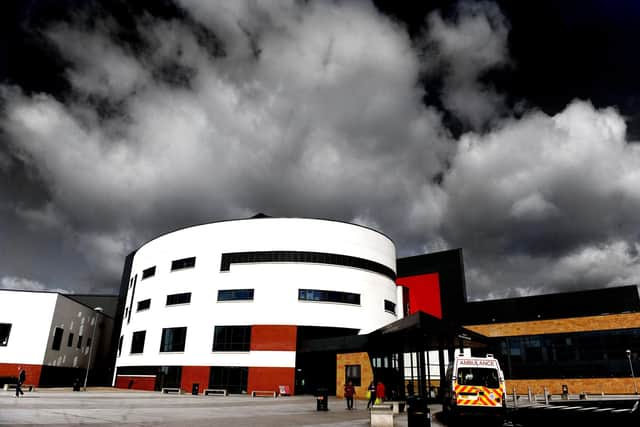

While last month, members of NHS Forth Valley health board had heard the welcome news that no contingency beds – five beds in wards meant for four patients – had been needed over the Christmas and New Year period, for the first time in several years.
But a performance update given to the board this week found that in January the Larbert hospital was once again operating at above the 107 per cent mean level of occupancy.
Director of nursing, Professor Karen Goudie told the board that while January had been “challenging”, there had been a marked improvement in many areas since last year.
She particularly noted an improvement in the number of bed days occupied by delayed discharges, with the number at the January 2026 census 1644 – a reduction from 2097 in January 2025.
Additional equipment, including a new CT scanner and a mobile MRI scanner, is also helping diagnostics, with endoscopy and imaging improving their performance.
However, Professor Goudie told the board that there is a national focus on the number of patients across Scotland waiting more than 52 weeks for scheduled care and NHS Forth Valley is currently helping other boards reduce waiting lists.
Members heard that is having an impact on waiting times for Forth Valley patients.
At the end of January 2026, the number of patients on the waiting list for a first outpatient appointment was 17,599 (17,074 excluding mutual aid) compared with 12,661 in January 2025.
The board is also continuing to miss its targets for treating cancer patients, with 66.2 per cent of patients waiting less than 62 days from urgent suspicion of cancer referral to first cancer treatment, compared with the December 2024 position of 78.8 per cent.
Other Scottish Government targets also remain elusive, in particular for emergency treatment.
Overall compliance with the four-hour emergency access standard (EAS) in January 2026 was 56.9 per cent; Minor Injuries Unit treated, admitted or discharged 99.9 per cent of patients within the four-hour target, while Forth Valley Royal’s Emergency department achieved just 45 per cent.
According to the report, a total of 2985 patients waited longer than the four-hour target across both the ED and Minor Injuries Unit (MIU); with 1526 waits longer than eight hours, 784 waits longer than 12 hours and 150 waits longer than 23 hours.
The report also notes that 915 patients attending ED in January 2026 did not wait to be treated.
Garry Fraser, director of acute services, told members that January into February is always the busiest time for the hospital but overall he noted “we have managed to keep planned care running except for one day, right through the the winter and that’s almost unheard of”.
Members heard that work continues throughout the hospital to improve the flow of patients from the front door into other wards, with ongoing projects to assess elderly, frail patients quickly, speed up discharge and cut the length of time patients stay in hospital.