
'Explain why scheme blocked bid to buy buses made in Falkirk' - MP wants answers from Scottish Government

An MP has questioned a decision not to award a funding bid which would have gone towards purchasing buses made in Falkirk.
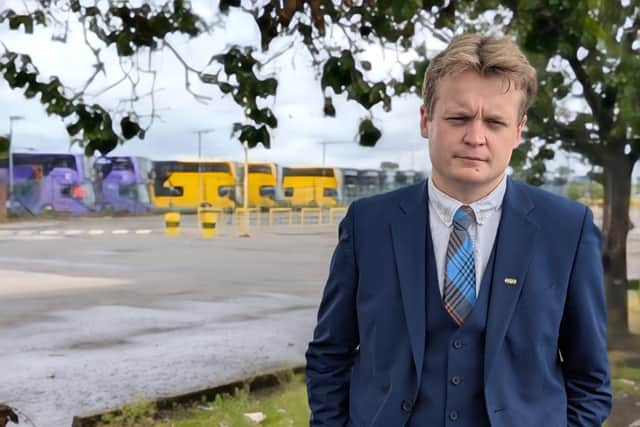
Euan Stainbank, Falkirk MP and co-chair of the British Buses All-Party Parliamentary Group said the legal challenge brought by McGill’s raises serious questions about the Scottish Government’s handling of the £45 million ScotZEB3 scheme.
The bus firm owners have launched their legal action against the Scottish Government after being rejected for for zero-emission bus funding.
McGill’s Buses, owned by brothers Sandy and James Easdale, was overlooked for cash in the last round of ScotZEB3.

The firm said if its £4.3 million funding bid had been successful, it would have purchased 33 zero-emission electric buses from troubled manufacturer Alexander Dennis in a bid to secure Scottish jobs.
The company has now taken the matter to the Competition Appeal Tribunal in a bid to overturn the decision and force the process to be reformed.
McGill's seeks to challenge how the bids were scored, overturn the funding decision, and force a comprehensive rethink of how zero-emission subsidies are allocated.
Mr Stainbank said: “ScotZEB3 should have supported Scotland’s bus manufacturing sector while helping to decarbonise Scottish transport. Instead, vehicles will be subsidised with Scottish taxpayers’ money while directly threatening jobs and our manufacturing capacity here.
“It is for the tribunal to determine the legal issues and for McGill’s to make its own case in court.
“The Scottish Government should commit to publishing the fullest possible explanation of the scoring process. It must explain to my constituents how its scheme ended up blocking bids to build cheaper buses in Falkirk while supporting more expensive bids to buy buses from China.”
Sandy Easdale said: “The move would have boosted Scottish jobs and enabled it to remove more diesel vehicles from its fleet across Scotland. The largest share – £13 million – was awarded to coach firm Ember to buy 100 Chinese electric coaches to expand its existing network, which would not result in any diesel vehicles being replaced.
“We have questionable decisions being made on large amounts of public money by nameless people in secret rooms who are trying to avoid scrutiny. Decisions on taxpayers' sums of this magnitude should be fully transparent and decision makers should be willing to be held accountable.”
His brother James Easdale added: “There is also a fundamental question about fairness and transparency in how this funding has been allocated. We have looked very closely at the scoring process and reached the inevitable conclusion that a legal appeal had to be submitted.”
Last year, the Scottish Government was forced to step in to fund a furlough scheme for staff at ADL after the firm announced it was considering consolidating its operations at a single site in Yorkshire, putting around 400 jobs at risk.
At the time, bosses said the firm would need an increase in orders if it was to become sustainable in the central belt.
Five days after the ScotZEB3 announcement, Alexander Dennis revealed that it was consulting on plans to close its Falkirk manufacturing facility and convert its facility in nearby Larbert into a chassis manufacturing site.
Speaking at the time, Alexander Dennis president and managing director, Paul Davies, said the results of the ScotZEB3 scheme were “incredibly disappointing”.
A Transport Scotland spokesperson said: “We are aware that McGill’s Buses has submitted a claim to the Competition Appeal Tribunal. As this matter relates to legal proceedings, it would not be appropriate to comment further at this stage.”