
Alexander Dennis to keep Camelon and Larbert sites open after £4m Scottish Government furlough deal
Bus building firm Alexander Dennis has confirmed its Scottish manufacturing sites – including Camelon and Larbert – will remain “open and operational” saving hundreds of jobs.
It had been feared over 400 jobs would be lost after the company announced proposals to close its manufacturing sites in Scotland and move production to its base in England.
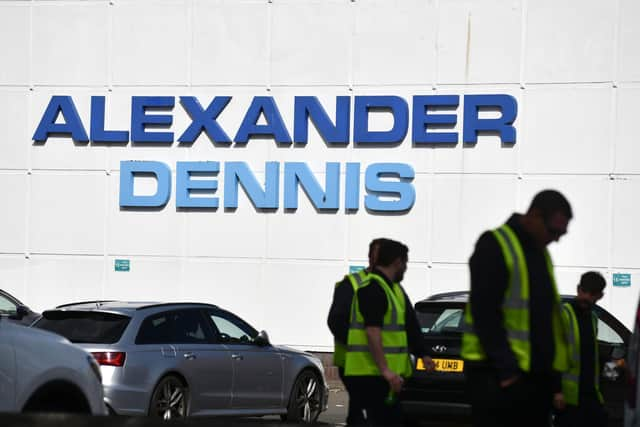

However, the company confirmed on Monday – the day its extended consultation closed – that it would be retaining its Scottish sites following “intensive engagement” with internal and external stakeholders.
They said the proposal was made possible through the advocacy and intervention of the Scottish Government and Scottish Enterprise, combined with the company’s trade union partners taking “a constructive, solution-focused approach”.
First Minister John Swinney confirmed approximately £4 million towards a furlough scheme on a visit to the firm’s Larbert site.
The scheme will be in place for 26 weeks for roles that are required to sustain future manufacturing capacity, to enable the required lead-times to get manufacturing back online.
To access the salary support funding, ADL will need to provide evidence of sufficient orders to sustain its operations in Scotland.
The company said it has seen increased demand for its single and double-deck buses in recent weeks, and is confident in the placement of further orders to support Scottish manufacturing.
Paul Davies, Alexander Dennis president and managing director, said: “We are deeply grateful for the Scottish Government’s commitment to preserving jobs, skills, and industrial capability in the region.
“Today’s announcement marks a turning point. The Scottish Government’s support allows us to propose a new outcome to our statutory consultation today.
"Together with our team members’ acceptance of new terms and conditions through the trade union ballot, and the confidence we have in securing new orders, we will be able to keep our manufacturing sites in Larbert and Falkirk open and operational. This decision saves hundreds of jobs within Alexander Dennis and supports our 1000 suppliers throughout the UK.
“This has been made possible by collaboration, determination, and a shared belief in the value and future of domestic manufacturing, which is a critical driver of Scotland’s economy.”
First Minister John Swinney said: “The Scottish Government wants to retain the manufacturing workforce of Alexander Dennis. My officials have discussed detailed terms with management and reached agreement on the principles of a company run furlough scheme.
“To access the Scottish Government funding, the company will need to provide evidence of orders that will enable its manufacturing to continue in Scotland. Although the details are commercially sensitive, I am aware Alexander Dennis is working hard to do that.
“This is intended to act as a bridge to a sustainable future for the company in Scotland. During this period, training will also be offered by Scottish Enterprise.
“It is essential we protect the skilled manufacturing jobs we need to build our transition to a green industrial economy.”
Adrian Gillespie, Scottish Enterprise Chief Executive added: “This welcome announcement signals a strong commitment to supporting and retaining vital Scottish manufacturing expertise in an important, growing market.
“We’ve reached this outcome through partnership working at its best, and I’d like to thank everyone involved for their dedication. Scottish Enterprise looks forward to working with the company to build a successful future in Scotland.”
Alexander Dennis’s original consultation process was launched in June in response to a rapidly changing competitive landscape. The proposal announced on Monday allows manufacturing operations in Scotland to continue and significantly limits the expected role reductions.
However, to improve its competitive position, Alexander Dennis continues to propose further changes to its business structure, with expectations that 11 roles not directly linked to Scottish manufacturing remain at risk of redundancy in the ongoing statutory consultation.